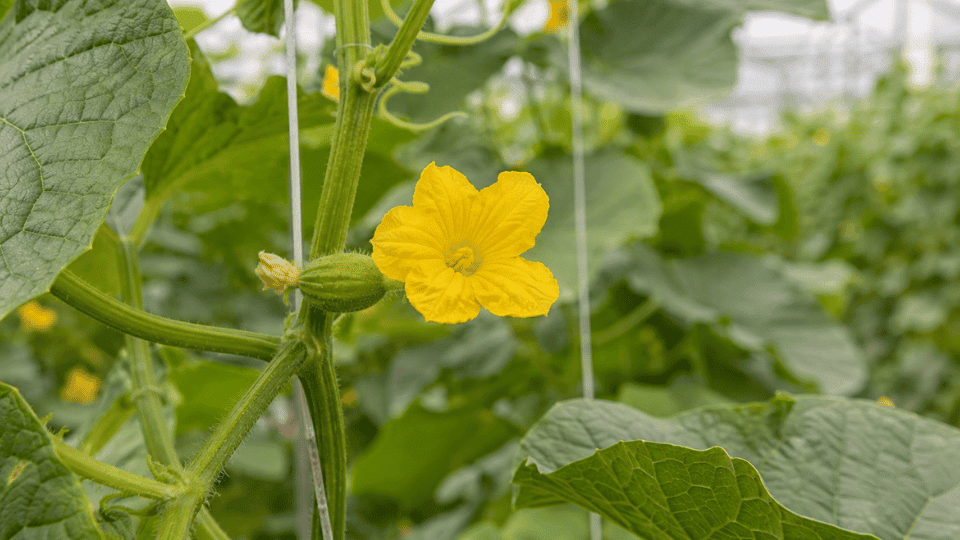
Phase 01 · Reproductive Start
Flowering & Pollination
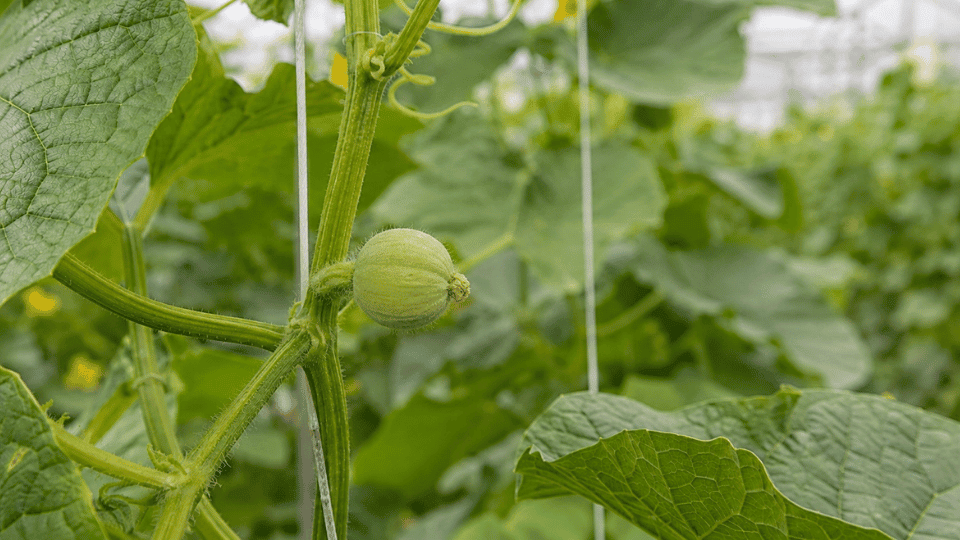
The reproductive transition produces flowers and establishes the potential sites from which successfully pollinated fruit may develop.
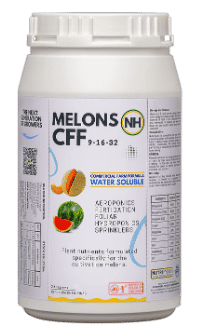
Hydroponic melon nutrition for humid-tropical production
Five-stage nutrition designed around the changing demands of premium melon production.
A 100% water-soluble Part B fertilizer used with Calcium Nitrate and separately managed Magnesium Sulfate from seedling establishment through ripening.
Nutrition changes as the melon crop develops.
Calcium and Magnesium remain independently adjustable.
Configured for protected melon production in tropical conditions.

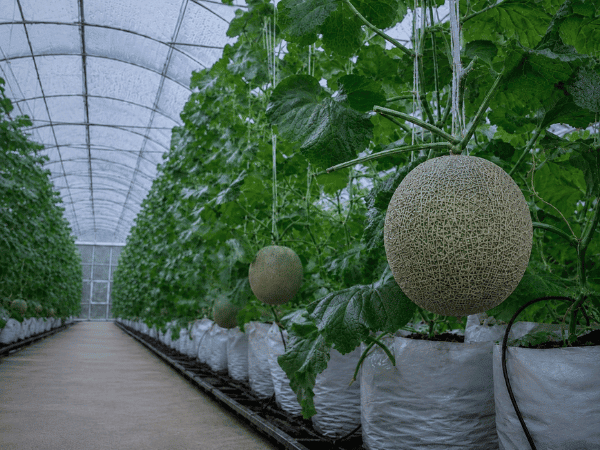
The Humid-Tropical Challenge
In humid-tropical protected cultivation, light, temperature, humidity, root activity and fruit demand can change rapidly. Nutrition and irrigation therefore have to respond to the crop as a living physiological system.

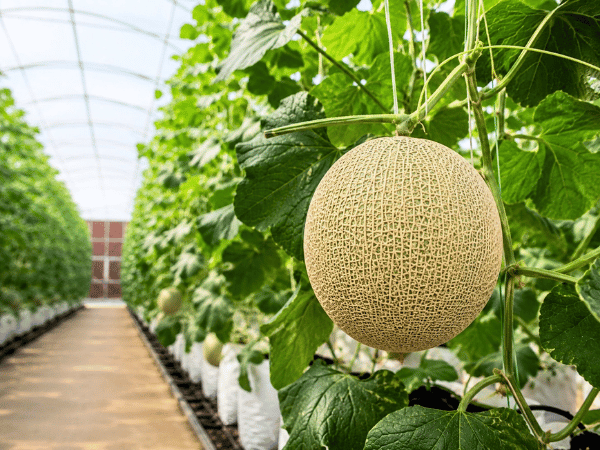
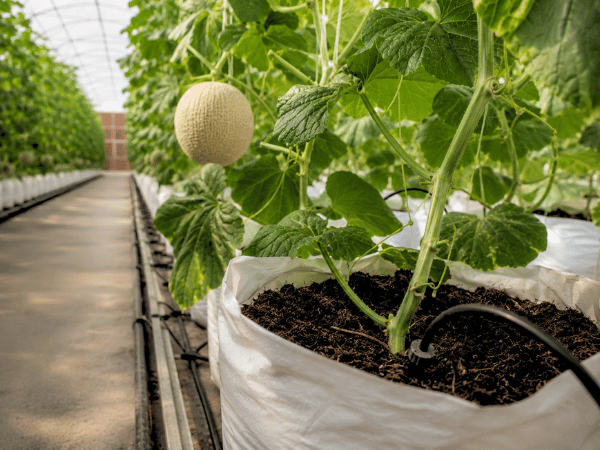
Higher nighttime temperatures increase maintenance respiration, consuming part of the carbohydrates produced during the day and reducing net daily carbon gain when daytime assimilation cannot compensate.
Fruit quality still depends on strong daytime photosynthesis and enough healthy source leaf area to support the developing fruit.
High relative humidity, low VPD and reduced radiation can sharply reduce transpiration and water demand while the root zone may remain wet.
Irrigation volume, root-zone oxygen and mineral delivery must be adjusted to actual crop demand rather than a fixed daily schedule.
After fruit set, the developing melon competes strongly for water, carbohydrates and mineral nutrients while the canopy must continue supplying photosynthate.
Crop load, canopy health, root performance and nutrient balance become increasingly important as reproductive demand rises.
Warm solution, oxygen limitation, poor drainage, salinity or unstable pH can restrict uptake even when the fertilizer formulation itself is correct.
Fertilizer cannot indefinitely compensate for a failing root environment. Root-zone management remains part of the nutrition system.
The crop changes. The environment changes. The feeding strategy has to respond.
That is the physiological logic behind Tropical Gold’s crop-stage approach.
Crop-Stage Nutrition Architecture
Melon physiology changes from establishment to harvest. Tropical Gold uses a decoupled nutrient architecture so Calcium Nitrate, Tropical Gold and Magnesium Sulfate can be managed as one stage-responsive crop program.
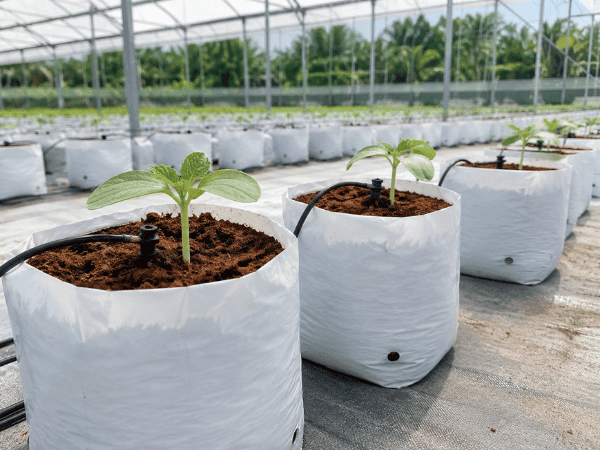
Develop an active root system, expand healthy early leaves and prepare the young plant for sustained vine growth.
Build enough root and leaf function to support rapid vegetative development.
The system logic: the nutrient program changes because the crop changes—from establishment, to canopy building, to fruit set, fruit filling and finally maturation.
Precision Nutrition
As melon physiology changes, nutrient emphasis changes with it. Canopy development builds the photosynthetic source, reproductive transition establishes new sinks, and fruit expansion increases demand for transport, water and mineral nutrition.
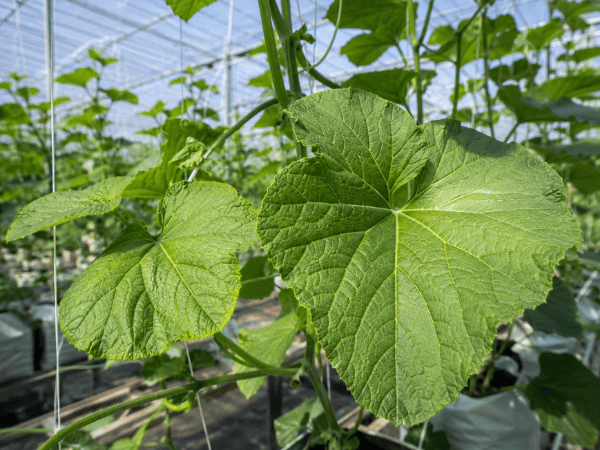
Nitrogen supports vegetative growth and leaf-area development, while Magnesium is central to chlorophyll and photosynthetic metabolism. Together they support the functional canopy that supplies assimilates to developing fruit.
More of one nutrient is not automatically better. Root-zone conditions, water relations, ion balance, canopy function and fruit load determine how effectively the crop uses the nutrient supply.
Tropical Conditions & Crop Steering
Melon water use and root-zone behavior can change quickly with radiation, humidity, temperature and prolonged cloudy weather. Management should follow the crop’s actual response rather than a fixed schedule.

High radiation → faster water use → faster dry-back
Water use rises and substrate dries faster. Salts can concentrate if irrigation does not keep pace.
Dry-back, irrigation and drainage, root-zone or drain EC, leaf temperature and root-zone temperature.
Increase irrigation only when crop demand justifies it. Maintain drainage; do not automatically raise fertilizer EC.
Manage irrigation and the root zone according to what the crop and substrate are actually doing—not according to a fixed habit.
How to Use Tropical Gold
Choose direct mixing or stock solution, enter your tank volume, then select the crop stage.
Enter the final irrigation-solution volume you want to prepare.
Enter a volume greater than zero.
Low-concentration establishment baseline for young roots and early leaf development.
Grower Operating Protocol
The nutrient recipe is only one part of crop management. Consistent monitoring of irrigation, the root zone, crop development and system performance helps the grower recognize changes early and make better-informed adjustments.
Use crop, root-zone and irrigation response to guide decisions rather than changing management from one isolated observation.
Before making changes, check whether the crop and root zone behaved as expected during the previous irrigation cycle.
Begin with the established crop-stage fertigation program. Adjust irrigation only when crop demand, root-zone condition, weather or system performance gives a clear reason to do so.
Verify irrigation distribution and root-zone drainage before changing fertilizer concentration.
Correct distribution, emitter or drainage problems before changing fertilizer concentration. Irrigation volume and frequency should follow actual crop water use and substrate behavior.
Look for patterns across plants and across the greenhouse rather than diagnosing the crop from one isolated symptom.
Yellowing, slow growth, poor fruit expansion or wilting can arise from nutrition, irrigation, root stress, environment, pests, disease or excessive crop load. Identify the limiting process before changing nutrition.
Compare today’s irrigation demand and crop response with previous days before deciding whether tomorrow should change.
Decide whether a change is actually justified. When practical, change one important variable at a time and observe crop response before making another major adjustment.
Follow trends rather than one isolated measurement.
Change one important variable at a time when practical.
Recheck crop response before another major adjustment.
Confirm the baseline before adjusting.
Canopy balance, root-zone auditing and structured diagnosis remain part of the operating system.
Train, prune and balance the crop without sacrificing the healthy leaf area needed to finish fruit.
Maintain a consistent training system so leaves, flowers and developing fruit remain accessible to light, airflow and crop work.
Periodically verify conditions that can alter nutrient balance, root performance and irrigation response.
Crop symptoms can have interacting causes, and appearance alone does not confirm nutrient deficiency.
Crop Looks Abnormal
Technical Center
Tropical Gold is the crop-specific Part B of a decoupled melon nutrition program. Explore its guaranteed analysis, operating assumptions, crop and system fit, and the technical principles needed to interpret fertigation measurements correctly.
Tropical Gold supplies the crop-specific Part B nutrient package. Calcium and Magnesium are intentionally managed independently through Calcium Nitrate and Magnesium Sulfate.
Bar lengths compare the declared percentages shown here. They are not nutrient sufficiency scores or recommended application ratios.
Intentional system design: Calcium and Magnesium are supplied independently through Calcium Nitrate and Magnesium Sulfate rather than being fixed inside Tropical Gold Part B.
These values are operating references for preparation and management of the final irrigation solution. They should always be interpreted together with actual source water, crop response and system conditions.
Tropical Gold is intended for professionally managed fertigation programs where source water, irrigation, root-zone condition and crop stage are actively considered.
Measurements become useful only when they are interpreted within the plant–water–root-zone system rather than treated as isolated targets.
EC represents the combined conductivity of dissolved ions in the solution; it does not identify the concentration of individual nutrients.
Increasing EC without considering crop stage, water demand and root-zone conditions can increase osmotic stress or salt accumulation.
Adequate fertilizer concentration cannot compensate for poorly aerated, overheated or unhealthy roots.
Calcium is transported mainly through the xylem, so effective delivery depends strongly on active roots, water movement, transpiration and vascular function.
Application rates and EC targets are operating baselines, not guarantees of yield, fruit size, fruit set, Brix or quality.
Nutrient concentration should always be interpreted together with crop stage, source water, irrigation response, root-zone condition and environment. When crop response deviates from expectation, investigate the limiting process before changing the fertilizer program.
From Flower to Premium Melon
Once flowering begins, the crop progressively shifts more resources toward developing fruit. Successful finishing depends on the combined performance of the canopy, roots, water supply, nutrient balance and growing environment throughout fruit development.
Phase 01 · Reproductive Start
The reproductive transition produces flowers and establishes the potential sites from which successfully pollinated fruit may develop.
Phase 02 · Developing Fruit Sink
After successful fruit set, the developing melon becomes an increasingly important sink for water, mineral nutrients and photosynthetic assimilates as expansion progresses.
Reproductive development begins and potential fruit sinks are established following successful pollination and fruit set.
The young fruit begins developing as a new sink for water, mineral nutrients and photosynthetic assimilates.
Fruit demand increases while canopy photosynthesis, root activity, water supply and nutrient balance remain essential to continued development.
The fruit becomes a dominant sink while a functional canopy continues supplying carbohydrates required for final development and soluble-solids accumulation.
Fruit development depends on the whole crop system. Functional roots support water and mineral uptake, the canopy supplies photosynthetic carbon, and balanced fertigation helps maintain the physiological processes required as fruit demand increases.
Tropical Gold progressively shifts nutrient emphasis across the crop cycle while Calcium and Magnesium remain independently managed within the complete program.
Premium melon production is the result of coordinated crop development, not a single finishing-stage input.
Frequently Asked Questions
Tropical Gold is designed for growers who want more control over melon fertigation across the crop cycle. These answers summarize the most common technical and practical questions about using the program.
No. Tropical Gold is the crop-specific Part B of a decoupled nutrient program. Calcium Nitrate supplies the separate Calcium and nitrate-N component, while Magnesium Sulfate is independently managed to supply Magnesium and additional Sulfur.
Keeping Calcium Nitrate, Tropical Gold and Magnesium Sulfate as separate nutrient inputs allows their relative supply to be adjusted across crop stages. It also prevents direct mixing of concentrated calcium solutions with concentrated sulfate- or phosphate-containing fertilizers, where precipitation risk can increase.
No. The Tropical Gold program changes across five crop stages: Seedling Establishment, Vine Run, Pollination, Fruit Bulking and Ripening. Each stage has different baseline rates and EC targets because crop demand changes as the canopy and fruit develop. Exact stage rates are provided in Section 07.
The target final nutrient-solution pH is 5.8–6.2. Measure pH after the nutrient solution is fully prepared and adjust as necessary according to the actual irrigation solution and source-water characteristics.
No. Higher EC is not automatically better. Excessive nutrient concentration can increase osmotic stress or root-zone salt accumulation, particularly when crop water use is low. EC should be managed in relation to crop stage, irrigation demand, root-zone conditions and the growing environment.
Source-water minerals contribute to the final nutrient balance. Measure source-water EC and, where possible, review a water analysis for Calcium, Magnesium, bicarbonate, Sodium, Chloride and other relevant ions. Significant mineral content may require adjustment of the program. EC alone does not identify which ions are present.
Yes, when the system is appropriately managed. For closed or recirculating systems, do not exceed 2.2 mS/cm without crop- and system-specific validation. Monitor EC, pH, root-zone conditions and system performance, and assess nutrient-solution composition where practical because individual ions can accumulate or become depleted at different rates over time.
Do not directly combine concentrated Calcium Nitrate with concentrated Tropical Gold or other concentrated sulfate- or phosphate-containing fertilizers. Dissolve the components separately and add them individually into a well-filled irrigation tank with good circulation. They can coexist appropriately once sufficiently diluted in the final irrigation solution.
A deficiency-like symptom cannot confirm nutrient deficiency by appearance alone. Check the environment, irrigation, substrate moisture, EC, pH, root health, pests, disease, crop stage and fruit load before changing the nutrient program. The underlying limiting process should be investigated before assigning a nutritional cause.
No fertilizer program can guarantee Brix, fruit size, yield or quality. Crop performance also depends on genetics, light, temperature, humidity, irrigation, root health, crop load, pollination, pest and disease pressure and overall management. Tropical Gold is designed to support stage-appropriate nutrition within that larger crop-management system.
The program is designed for melon and cucurbit fertigation, including Cantaloupe, Honeydew, Musk Melon and Watermelon. Final management should still be adjusted for cultivar, crop stage, production system and growing conditions.
Tropical Gold is primarily designed as a water-soluble fertigation fertilizer for controlled melon production. Soil-based use requires greater consideration of soil nutrient status, pH, salinity, buffering, native fertility and irrigation-water chemistry, so the controlled-fertigation baseline rates should not automatically be transferred directly to soil-grown crops.
Consider crop stage, source water, growing medium, irrigation method, current EC and pH, root-zone condition and greenhouse environment together.
Purchase · Commercial · Technical Trial
Ready to order, evaluating Tropical Gold for commercial production, or planning a controlled comparison? Choose the pathway that matches what you need next.
Buy Tropical Gold directly from NutriHydro or through your preferred marketplace.
Direct
NutriHydro
Official direct purchase
↗
Marketplace
Shopee
Marketplace purchase

↗
Marketplace
TikTok Shop
Marketplace purchase

↗
Marketplace
Lazada
Marketplace purchase
↗
Larger farm, recurring supply, or implementation support?
For larger-volume supply or technical implementation, start with the crop, production system and scale that define your operation.
The same inquiry form is used for both commercial farms and technical trials. Your inquiry type will be selected automatically.
Compare the program under conditions that are as similar as practical to your present production baseline.
The same form is used for commercial and trial inquiries. Technical Trial Request will be selected automatically.
Share enough information for us to understand your crop, production system, scale and objective. Commercial Farm and Technical Trial requests use this same form.
Discount Applied Successfully!
Your savings have been added to the cart.