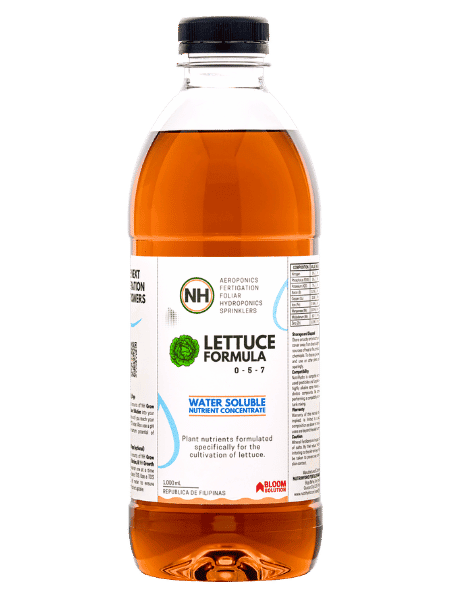
NH Lettuce Formula
A precipitate-free, 2-part liquid super-concentrate engineered to grow export-grade, high-density hydroponic lettuce in Philippine heat — locked to a precise 1:1 Nitrogen-to-Potassium ratio for dense, crisp, tip-burn-free heads.
N : K LOCK: 1 : 1
TIP-BURN: NONE
FE @ pH 7.0: BIOAVAILABLE
An Elite Technical Feat Only 6 Companies in the World Can Achieve
Standard hydroponic formulas require heavy, low-density dosing configurations (often requiring 2.5 mL to 5.0 mL of concentrates per liter of water) to register an Electrical Conductivity (EC) of 1.2.
NutriHydro Lettuce Formula is engineered as a liquid super-concentrate. It hits a powerful 1.2 EC with just 1 mL per Liter of water. We are proud to be one of the six agronomic developers globally capable of stabilizing mineral nutrients at this intensity without chemical fallout or precipitation.
1 mL of Part A + 1 mL of Part B achieves full-strength targets.
Unmatched mineral payload bioavailability delivered instantly.
One of six manufacturers globally holding this formulation density.
Zero crystallizations or dropouts in lines, tanks, or injectors.
Four ways tropical heat ruins a lettuce crop
Commercial hydroponics in the Philippines fails in predictable ways. The formula is engineered specifically to neutralize each one.
Marginal Necrosis (Tip-Burn)
When monsoon humidity exceeds 95%, transpiration stalls and immobile Calcium can no longer climb to the newest leaves — the margins collapse into brown, unsellable necrosis.
Pythium & Warm-Water Rot
Above 28°C the reservoir loses its ability to hold dissolved oxygen. Hypoxic roots are colonized by Pythium within hours, collapsing the entire batch.
Wilting & Premature Bolting
Above 35°C, nitrogen-heavy feeds drive rapid internode elongation (bolting) and bitter compounds, while the canopy wilts at mid-day.
Iron Precipitation & Chlorosis
Philippine deep-well water is heavy in bicarbonates. As pH drifts above 6.5, standard iron oxidizes and drops out of solution, yellowing the leaves.
One stable ratio. Three rising doses.
Lettuce is steered by volume, not by switching formulas. The 1:1 N:K ratio stays locked while the dose climbs from seedling to harvest. Select a stage to see the target.
Seedling & Transplant
Low osmotic pressure for rapid root initiation and balanced uptake — building the root system without inducing salt stress.
Vegetative Expansion
Maximizing Leaf Area Index (LAI) and vascular development. Nitrogen is held moderate to prevent weak, elongated growth under greenhouse heat.
Peak Finishing
Turgor optimization and stress-resistance activation for maximum harvest weight. Potassium supercharges phloem loading for crispness; Sulfur triggers heat-protective antioxidants.
*Target EC is the conductivity from fertilizer alone. Add your source water's baseline EC to set the absolute target.
The Full 12-Element Matrix
No horizontal scrolling. Tap any stage below to dynamically overlay target parameters instantly.
Why this liquid stays clear at commercial density
Three engineering decisions separate the NH Lettuce Formula from generic powders that clog dosers and crash out of solution.
The 1:1 N:K Lock
Holding Nitrogen and Potassium in exact equilibrium regulates the vacuole's osmotic potential, forcing aggressive water uptake into the cells. The result is dense, turgid heads that snap crisp instead of the flaccid tissue typical of high-nitrogen tropical feeds.
High Solubility Potassium & Sulfate
By completely eliminating low-solubility Potassium, this formula is engineered using only premium, ultra-soluble mineral inputs. This precipitate-free design guarantees the concentrate stays fully clear at commercial strength and feeds cleanly through peristaltic pumps and automated venturi injectors.
DTPA / EDDHA Iron Payload
Philippine deep-well water is alkaline. A premium dual-chelate iron system (DTPA with an EDDHA failsafe) keeps iron bioavailable up to pH 7.5, eliminating the interveinal chlorosis that plagues bicarbonate-heavy source water.
Three ways to run it
Whatever your facility's architecture, the formula drops in. Pick your method.
- Insert the Pump A suction line directly into the NH Lettuce Formula Super Concentrate A, and the Pump B line into NH Lettuce Formula Super Concentrate B.
- Program the dosing computer to pull Part A and Part B at a strict 1:1 ratio (equal volumetric parts).
- Enter the target EC for the crop's current stage. The computer pulses the pumps to hold that baseline automatically.
- Place the Part A injector upstream of the Part B injector so Part A fully dilutes into the main line before Part B is introduced.
- Set injection rates by stage: 0.50 mL/L each (Seedling), 0.80 mL/L each (Vegetative), 1.00 mL/L each (Finishing).
- Verify the delivered EC at an emitter and adjust against your source-water baseline.
- Fill the reservoir to 80% capacity with clean water and start the circulation pump.
- Add Part A first; circulate 3–5 minutes until fully dispersed. Never pour the concentrates together.
- Add Part B; circulate another 3–5 minutes.
- Top off to the final mark, circulate 10 minutes, then adjust pH to 5.8–6.2.
Mix the exact NH Lettuce Formula dose
Select the crop stage and tank volume. The calculator shows the Part A and Part B dose, fertilizer EC target, and the complete 12-element ppm matrix.
Low osmotic pressure for early root initiation.
Mixing order: water → Part A, circulate 3–5 mins → Part B, circulate 3–5 mins → adjust pH to 5.8–6.2.
Keep the closed loop honest
In recirculating systems the solution drifts. Tap any rule below to access targeted steering actions.
Begin with source water below 0.5 mS/cm. Bicarbonate-heavy deep-well water pushes pH up and precipitates iron — pre-treat before you fertigate.
Nitrate-dominant lettuce feeds drift the pH upward. Maintaining a strict window limits physiological chlorosis.
Under tropical greenhouse heat, lettuce drinks water faster than nutrients, concentrating mineral salts inside the loop.
Accumulations of organic root exudates and imbalanced mineral ratios corrupt absorption dynamics over time.
Calibrated for commercial lettuce
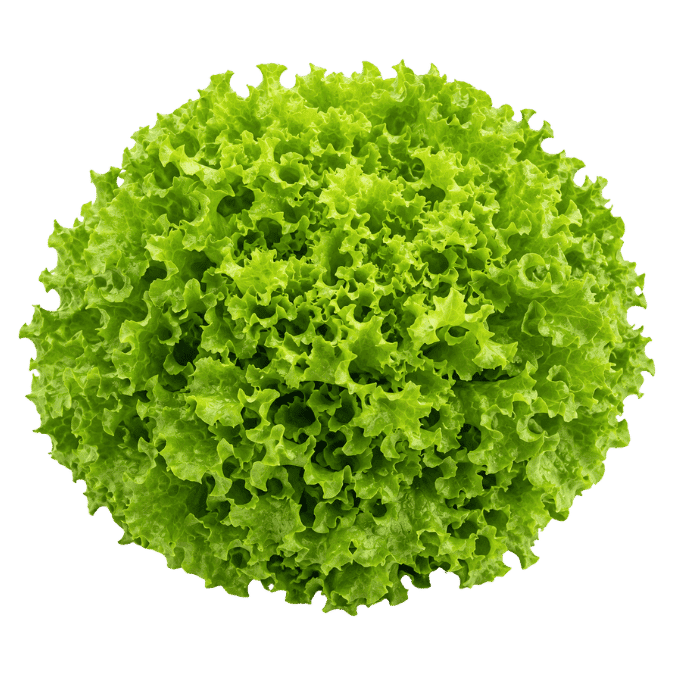
Tuned for the specific leafy-green cultivars grown across Philippine CEA and lowland greenhouse operations.
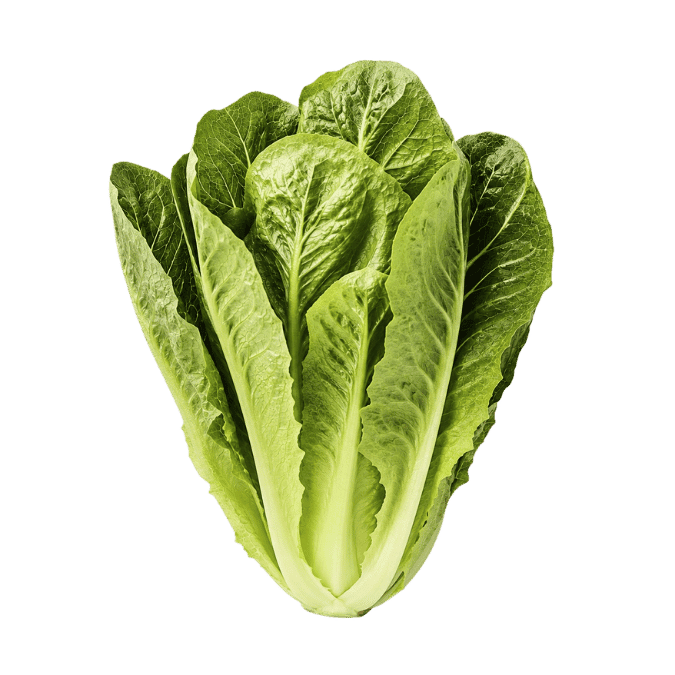
Romaine Profile
Romaine requires strict turgor lock (1:1 N:K ratio) to prevent cell wall collapse and marginal tip-burn during the final 5 days.
What success looks like
Composition
Combined 2-Part Set Active Concentration · Blended % W/V
Frequently asked questions
Part A carries the Calcium and Part B carries Phosphate and Sulfate. If the two concentrates touch before they're diluted in the tank, they instantly form insoluble calcium phosphate and calcium sulfate. Dispersing Part A fully into the water first keeps everything in solution.
Equal Nitrogen and Potassium balances the osmotic potential inside the cell vacuole, driving aggressive water uptake without nutrient lockout. That is what gives the head its dense, crisp, turgid texture instead of the soft, flaccid growth you get from high-nitrogen tropical feeds.
Yes. The formula uses a premium DTPA chelate with an EDDHA failsafe, keeping iron bioavailable up to pH 7.5 — well above the point where ordinary iron sources oxidize and precipitate out. Still, start with source water below 0.5 mS/cm and manage bicarbonates with pH Down.
That's exactly what it's built for. The precipitate-free, Split-Potassium liquid feeds cleanly through peristaltic pumps and venturi injectors with no clogging — just set the doser to a 1:1 A:B ratio and target the stage EC.
It means unmatched concentration density. Most competing products require twice or three times the fluid volume to deliver the same amount of active ions to your plants. This is an elite formulation standard. It means you ship less water, buy less plastic, save storage space, and run automated systems far more precisely with zero crystallizing risk.
Keep the fertilizer EC within the stage targets (up to 1.2–1.3 mS/cm at finishing, achieved precisely at a 1.0 mL/L dosage rate). In a closed loop under heat, salts concentrate as the crop transpires — top off daily with fresh water and don't let the reservoir drift past 1.8 mS/cm, which becomes phytotoxic.