Lettuce Cultivation Protocol | A Biological Approach
System Optimization:
Technical setups for NFT, DWC, and hybrid hydroponic systems.
Environmental Control:
Managing Vapor Pressure Deficit (VPD) to maintain transpiration in varied climates.
Integrated Pest & Disease Management (IPDM):
Utilizing protein-based bio-controls like NH Caternix for sustainable protection.
Substrate Preparation:
Advanced buffering techniques for cocopeat to optimize Cation Exchange Capacity (CEC).
PHASE 1: THE FOUNDATION
Media Preparation & Bio-Security
A Sterilization Reset
Substrate sanitation is the primary barrier against crop-cycle failure.
The Risk: Raw or reused media acts as a biological reservoir. Fungal pathogens like Fusarium cause irreversible vascular collapse, while Fungus Gnat larvae physically devour root hairs. Skipping this step allows dormant pathogens to "wake up" the moment you begin irrigation, resulting in catastrophic root rot within the first 10 days.
The Solution: Deploy an oxidative burst using NH Hydrogen Peroxide 12% to chemically dismantle pathogen cell walls and larvae on contact.
Sterilization Protocol
- Input: NH Hydrogen Peroxide 12%
- Dosage: 84 mL per Liter of water
- Action: Soak media for 24 hours. Rinse thoroughly.
B Cation Buffering
Satisfying the Cation Exchange Capacity (CEC) of the medium.
The Risk: Cocopeat is naturally "hungry" for Calcium and Magnesium. If unbuffered, it acts as a chemical vacuum, literally stripping these essential nutrients out of your fertilizer solution. The plant suffers immediate "Lockout" because the nutrients are bound to the media instead of the roots, leading to stunted growth and yellowing.
The Solution: Pre-saturate the media's exchange sites with NH CalMag to ensure all subsequent fertilizer doses go directly to the plant.
Buffering Protocol
- Input: NH CalMag (or NH Calcium Nitrate)
- Dosage: 1 tsp per 5 Liters of water
- Action: Soak for 24 hours after sterilization.
C Surface & System Sterilization
Eliminating cross-contamination pathways across the facility.
1. Work Area & Tool Sanitation
The Risk: Tools and benches act as a viral superhighway. Hands and shoes transport microscopic spores that bypass your media sterilization efforts. Even after a "cleanup," dormant pathogens remain in scratches and pores of benches for months, ready to re-infect.
The Solution: Establish a sterile boundary by misting surfaces before every single task. This is critical when recovering from a recent outbreak to neutralize lingering "bunker" pathogens before they touch the crop.
Sanitation Protocol
- Surfaces: Mist tools and benches with NH H2O2 (20–40 mL/L).
- Hands: Apply 70% Ethyl or Isopropyl Alcohol before every task.
- Action: Disinfect equipment and hands before entering the production zone.
2. Reservoir & Irrigation System Reset
The Risk: Irrigation pipes harbor Biofilm—a slimy bacterial shield that acts as a Pathogen Bunker. Pythium and Phytophthora hide inside these layers, protected from standard treatments. If not stripped away between cycles, this bunker releases billions of spores, infecting new crops instantly.
The Solution: Use professional line-cleaners to dissolve the biofilm matrix and purge pathogens from the internal plumbing.
System Reset Protocol
- Input: NH Aquaclaro (Tablets/Powder)
- Dosage: 2 gram per 20 Liters
- Action: Recirculate for 24–48 hours between cycles.
PHASE 2: CHEMISTRY
Nutritional Pathways & Stock Solution Protocol
Phase 2.1: Chemistry & Bio-Availability
Hydroponic success begins with total solubility. Phase 2.1 defines the bridge between raw water preparation and chemical stability. By neutralizing your solvent (water), you ensure that every mineral ion remains available for biological uptake rather than bonding into insoluble grit.
Prerequisite: Source Water Analysis
Fix the water before adding minerals to prevent chemical antagonism.
A. Chlorine & Chloramines
The Science: Municipal water sanitizers are indiscriminate oxidizers designed to kill all microbial life.
The Risk: Sanitizers treat beneficial probiotics (NH Amylis) as pathogens, killing your living shield instantly.
The Action: Off-gas water for 24 hours or aerate heavily to neutralize before adding biologicals.
B. Alkalinity (Bicarbonates)
The Science: Alkalinity is the water's "buffer strength"—its internal resistance to downward pH shifts.
The Risk: High alkalinity causes "pH Bounce," locking out Iron (Fe) and triggering leaf yellowing.
The Action: Use initial doses of NH pH Down to neutralize bicarbonates before final pH calibration.
Phase 2.2: Nutrition Pathway Selection
NutriHydro provides two distinct technical paths for lettuce production. Select the system that aligns with your farm's scale, infrastructure, and management objectives.
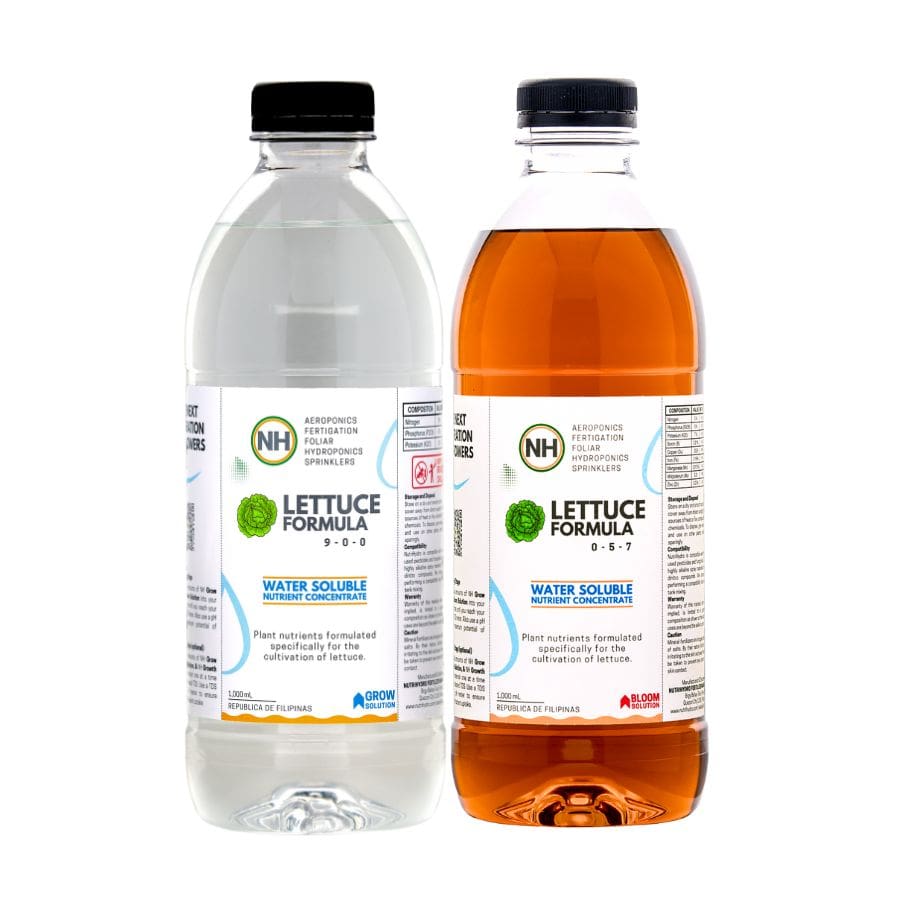
NH Lettuce Formula
Liquid Concentrate System
A pre-stabilized, pharmaceutical-grade liquid solution. Utilizing ultra-pure minerals, it eliminates mixing variables and prevents chemical drop-out, ensuring a perfect ion balance in every dose.
Designed for high-precision indoor farms and hobbyist greenhouses where absolute reliability and "plug-and-play" simplicity are the primary requirements.
Ensures Uniform Harvest Weight. Because every plant receives an identical ion profile, the system prevents "lagging" plants, resulting in consistent crop cycles and predictable crate volume.

NH Lettuce CFF
Commercial Farm Formula (Dry)
High-density dry salts engineered for maximum solubility and scale. Requires thermal processing (70°C water) to unlock minerals and pasteurize the solution for long-term storage.
Engineered for large-scale commercial greenhouses where logistical efficiency, nutrient steering control, and low input-cost-per-head are critical for farm ROI.
Delivers Maximum Biomass Potential. Allows growers to steer the crop toward structural hardening, creating the heavy, crunchy leaf profile and extended shelf-life demanded by premium retailers.
Stock Solution Preparation (CFF)
High-density stock solutions are the bridge between raw dry minerals and a precision-fed commercial crop. Phase 2.3 outlines the specific thermal protocols required to ensure total ionic separation, preventing the formation of insoluble chemical sludge and ensuring maximum bio-availability at the root surface.
Critical Mixing Rules
Ionic Simulator
The Science: The Dielectric Buffer
This simulator visualizes the Dielectric Constant of water. In a Diluted state, water molecules form a "hydration shell" around each ion, acting as a physical and electrical insulator. In a Concentrated state, these shells collapse, allowing Calcium ($Ca^{2+}$) and Sulfates ($SO_4^{2-}$) to bond instantly into a solid crystalline lattice.
Systemic Consequences of Precipitation
PHASE 2.1: PRECISION MONITORING PROTOCOL
You cannot manage what you do not measure
Technical Parameters for Hydroponic Management
Commercial success in hydroponics is dictated by the precise management of the root zone environment. In a high-turnover crop like lettuce, physiological imbalances lead to immediate yield loss and reduced post-harvest shelf life. This protocol outlines the Six Critical Parameters required for data-driven cultivation. By maintaining these metrics within established agronomic bands, growers ensure optimal nutrient solubility, respiratory health, and metabolic efficiency. Practical monitoring transforms the reservoir from a variable input into a stabilized growth engine.
pH Level
Dictates chemical availability. Proper pH prevents ions from bonding into insoluble solids.
If High: Titrate with NH pH Down (Nitrogen base). If Low: Incrementally add NH pH Up (Potassium base) or add fresh water to raise pH levels. Always adjust in small steps.
Nutrient EC / TDS
Measures total salt concentration. Distinguishes between uptake and salt accumulation.
If High: Dilute reservoir with fresh dechlorinated water. If Low: Add equal parts Stock A and Stock B to increase concentration.
Dissolved Oxygen
DO is the prerequisite for ATP production. Oxygen fuels aerobic respiration, providing the metabolic energy (ATP) required to "pump" nutrient ions across root membranes against the concentration gradient. Without DO, roots cannot "burn" sugars, the pumps stall, and nutrient uptake stops entirely.
If Low: Increase aeration volume or add air stones. Pulse dose NH H2O2 12% for an immediate oxidative oxygen burst to the rhizosphere.
ORP (Sterility)
Measures oxidation potential. Ensures reservoir is hostile to waterborne pathogens.
If Low: Path A: Pulse NH H2O2. Path B: Re-populate beneficials. If High: Halt H2O2 dosing and allow natural dissipation.
Water Temperature
Directly affects gas solubility. Prevents premature bolting and maintains DO capacity.
If High: Use chillers, wrap reservoirs in reflective insulation, or use frozen water bottles. If Low: Use inline heaters.
Air VPD (Vapor Pressure)
Regulates transpiration. Essential for the transport of immobile nutrients like Calcium.
If VPD Low: Increase ventilation and exhaust. If VPD High: Activate foggers or misters to increase ambient moisture.
PHASE 3: PHYSIOLOGY
The Three Pillars of Environmental Control
The Core Concept: Mastering the Metabolic Engine
Nutrition is the fuel, but Physiology is the engine. Phase 3 focuses on managing the environmental variables that dictate how fast a plant can process those nutrients. By optimizing light (DLI), humidity (VPD), and root oxygen (DO), you ensure the plant's internal "conveyor belts" are moving at peak efficiency.
1. Photosynthesis
Light Integral (DLI)
Think of light as the "Caloric Intake" of the plant. Photons fuel the creation of sugars (carbohydrates) that build physical biomass. More usable light equals more "food" for the plant to convert into heavy, crunchy leaf tissue.
Low light forces "etiolation" (stretching) and weak cell walls. High-intensity heat without management causes bolting and bitter leaves.
Utilize adjustable shade nets. Balance photon delivery with canopy temperature to prevent metabolic shutdown during peak noon.
- Targets: 14-17 mol (Hard Romaine) | 10-14 mol (Soft Batavia).
- Day Action: Open nets during cloudy hours to maximize intensity. Deploy nets during high-heat solar peaks.
- Measurement: Check PAR levels at the center of the crop canopy daily.
2. Transpiration
Vapor Pressure (VPD)
Transpiration is the "Delivery Truck" for nutrients. As leaves evaporate water, they create a vacuum that pulls Calcium from the roots to the leaf tips. Without this evaporation "pull," immobile nutrients cannot reach new growth.
Stagnant, humid air (Low VPD) stops the pump. Calcium fails to reach leaf edges, causing cell collapse known as Tip Burn.
Introduce active horizontal airflow to break the humidity boundary layer. Use foggers if air is too dry (High VPD).
- Airflow: Maintain 0.5-1.0 m/s velocity using high-capacity fans across the canopy.
- Foliar Dilution: Mix 1 mL NH Bio CalMag per Liter of water.
- Action: Spray weekly during cooler hours to bypass root limitations and reinforce cell walls.
3. Respiration
Root Oxygen (DO)
Dissolved Oxygen is the "Work Energy" for the root system. Roots must "breathe" to turn leaf sugars into the ATP energy required to actively suck up nutrient ions. No oxygen means the roots cannot do the work of feeding.
Warm water (>28°C) leads to Hypoxia. Roots switch to fermentation, stalling nutrient uptake and inviting Pythium (root rot).
Maximize oxygen saturation via high-pressure aeration and chemical oxygen pulse dosing in recirculating systems.
- Hardware: Deploy high-volume air stones to ensure surface gas exchange is constant.
- Dilution: Add 4 mL to 6 mL of NH Hydrogen Peroxide 12% per Liter of reservoir water.
- Maintenance Action: Apply dose weekly to provide an immediate oxidative oxygen burst to the rhizosphere.
PHASE 4: DOSING SCHEDULE
Dosaging NH Lettuce Nutrients
A Option A: Lettuce Formula (Liquid Concentrate)
The High-Precision Pathway: Pre-stabilized for absolute consistency.
| Target Cycle | Dosage (mL/L) | Target Parameters | Cultivation Objective |
|---|---|---|---|
| Full Cycle | 1.5 mL Solution A 1.5 mL Solution B | 1,250 PPM (Factor 700) ~1.8 EC | Standardized Stability. Fixed 1.5 mL ratio removes variable-input risks. Ensures a pharmaceutical-grade ion balance throughout the entire harvest window. |
B Option B: Lettuce CFF (Nutrient Steering Pathway)
Commercial Strategy: Adjusting A:B ratios to drive specific metabolic outcomes.
| Stage | Steering Dosage | Target Parameters | Steering Logic |
|---|---|---|---|
| Seedling Day 1-20 | 1.0 mL Stock A 1.0 mL Stock B | ~580 PPM ~0.8 EC | Low-Pressure Start. Balanced ratio at low concentration ensures young root membranes establish without osmotic burn. Focus is on root-hair density. |
| Vegetative Day 21-35 | 2.2 mL Stock A 1.8 mL Stock B | ~1,200 PPM ~1.7 EC | The "Nitrogen Push." Steering toward Stock A increases Calcium Nitrate levels. This fuels rapid cell division and canopy expansion to maximize leaf surface area. |
| Maturation Day 36+ | 2.0 mL Stock A 2.8 mL Stock B | ~1,320 PPM ~1.9 EC | Structural Hardening. Steering toward Stock B increases Magnesium, Sulfur, and Micronutrients. This reinforces cell walls, creating the "Crunch Factor" and extending post-harvest shelf life. |
PHASE 5: CROP PROTECTION
Sanitation Reset & Biological Fortification
Define Your Bio-Security State
⚠️ SIMULTANEOUS mixing is fatal. Never add oxidizers directly to biologicals.
The Logic of Separation (Why Timing Matters)
The Science (Incompatibility)
Hydrogen Peroxide is an indiscriminate oxidizer. If present, it will chemically dismantle the active bio-complex. You cannot build a living shield in an active oxidative environment.
The Agronomy (Dissipation)
H2O2 is unstable and breaks down into oxygen and water. Once residual peroxide has dissipated (ORP < 300mV), the system is safe to transition to a "Biological" state.
Commercial ROI
Adding biologicals to active H2O2 is a waste of capital. Proper sequencing ensures your biological investment survives to colonize the crop.
Sanitize (Sterile State)
Oxidative Neutralization. Employs high-energy oxidation to chemically dismantle the cell membranes of pathogens on contact. It acts as a liquid "Clean Room" reset for the reservoir and irrigation lines.
Creates a Biological Vacuum. Sterile water has no natural immunity; if a pathogen enters after the oxidizer dissipates, it replicates exponentially without competition, often leading to sudden outbreaks.
Maintain strictly consistent dosing intervals to prevent windows of vulnerability. Path A is most effective when used as a "Deep Clean" system reset before transitioning to Path B.
Preparation: Dose 0.5 mL per Liter of NH Hydrogen Peroxide 12% directly into the reservoir.
Application: Pulse every 48-72 hours. Target a stable ORP of 350-450mV.
Biological Standard
Competitive Colonization. Beneficial agents populate the root zone and reservoir, consuming "free" nutrients (organic exudates) that pathogens require to survive. By occupying all physical "parking spaces," it creates a fortress roots.
Oxidative Sensitivity. Residual chlorine or H2O2 will neutralize the living shield. Successful colonization requires a "Low ORP" window to allow the bio-agents to establish dominance.
Inoculate with NH Amylis PROACTIVELY before symptoms appear. This establishes a permanent, self-regulating immune system for the reservoir that is more stable than reactive chemical treatments.
Application: Dose the activated stock into the main reservoir. Dilute at a maintenance rate of 50 mL per Liter. Inoculate weekly to maintain colony dominance.
System Control: Maintain system ORP below 250mV to ensure bio-stability. High ORP indicates oxidative stress that will destroy the shield.
Advanced Strategy: The Sequential Pulse Reset
Purge-then-Protect. A sequential loop that uses oxidation (Path A) to clear accumulated pathogen loading, followed by NH Amylis (Path B) to populate the clean system with beneficials.
The Termination Error. Adding NH Amylis while residual H2O2 is still active. This kills the incoming beneficial army instantly, resulting in a failed inoculation and wasted biological investment.
Use an ORP Meter as the absolute gatekeeper. Never inoculate until the oxidative potential has naturally dissipated to safe levels, ensuring a hospitable environment for bio-agents.
Step 1: Pulse NH H2O2 at 0.5 mL/L.
Step 2: Monitor ORP.
Step 3: Once ORP < 250mV, inoculate with activated NH Amylis to secure the system.
Systemic Protection Layers
"Systemic" in biological management refers to system-wide ecological fortification and the activation of the plant's internal Systemic Acquired Resistance (SAR). It is not the use of systemic chemical pesticides.
Foliar Defense (Living Armor)
NH Subamo
Microscopic Surface Saturation. Proprietary bio-active agents saturate the leaf surface, forming an invisible, competitive barrier. This "Shield" occupies every possible micron of space, leaving no room for pathogens to find an entry point.
Pathogens act as "Invisible Hijackers." Airborne spores land on vulnerable surfaces and drill "infection pegs" to steal nutrients. Once inside, they replicate exponentially, causing necrotic lesions. Without a bio-active film, the leaf has zero physical defense against this drilling mechanism.
Apply weekly BEFORE disease appears. Biological fortification is more stable and reliable than chemical control because it creates a persistent living layer that pathogens cannot "bypass" through mutation. Unlike chemical fungicides that trigger a resistance loop, this physical biofilm remains effective indefinitely, allowing growers to avoid toxic pesticides entirely.
Timing: Apply during the "Stomata Window" (Dawn/Dusk) to maximize uptake.
Frequency: Apply weekly PROACTIVELY.
Vector Control (Biological Trojan)
NH Bebass & NH Aizure / Caternix
Targeted Metabolic Disruption. Bio-active agents bypass a pest's natural defenses to disable their internal organs or digestive tracts, while remaining completely inert and harmless to humans and beneficial insects.
Pests are "Biological Syringes." Aphids and thrips inject systemic viruses directly into the sap stream. Chewing pests stall photosynthesis by stripping leaf area. A single insect immigrant can trigger a farm-wide viral outbreak that compromises the entire cycle's marketability.
Apply proactively to establish a pesticide-free zone. This method avoids **Pesticide Neurotoxins** (Organophosphates) which paralyze nerves and risk worker health. While insects evolve "Super Bug" resistance to single-target toxins, biologicals attack via multiple pathways, providing a stable, resistance-proof strike.
Timing: Apply at first sign of vector activity or proactively every 10 days.
Frequency: Proactive application ensures zero "window of vulnerability."
PHASE 6: BIO-STIMULANTS
Biological Efficiency Leading to Metabollic Acceleration
NH Bio Grow
Vegetative AcceleratorMetabolic Priming: Supplies L-Amino Acids directly to leaves, bypassing the energy-expensive Nitrate-to-Amino conversion tax. Saves ATP to eliminate transplant shock and build biomass faster.
Use during the Lag Phase (Post-Transplant) and the Vegetative Phase for primary growth expansion.
Dosage: 1 mL per Liter.
Frequency: Max 2x per week.
Apply on alternate days with Bio CalMag. Spray fine mist on foliage at dawn or dusk.
NH Bio Bloom
Heading & Weight BoosterPhytohormonal Signaling: Introduces Auxins and Cytokinins to signal cellular division and differentiation. It forces lateral expansion, increasing the visual volume and density of the crop.
Use strictly during the Heading Phase to maximize lateral expansion and final head weight.
Dosage: 1 mL per Liter.
Frequency: Max 2x per week.
Apply on alternate days with Bio CalMag. Targets growing tips and leaf undersides for maximum response.
NH Bio CalMag
Structural BypassStructural Bypass: Delivers chelated Calcium and Magnesium via leaves to bypass root limitations (transpiration dependence). Reinforces cell walls to prevent Tip Burn and boosts Chlorophyll production.
To be used throughout the entire life cycle as the primary structural defense.
Dosage: 1 mL per Liter.
Frequency: 1x per week.
Use in alternate days with Bio Grow (Vegetative phase) or Bio Bloom (Heading phase).
The "Alternate Day" Rule
To maximize biological absorption and prevent leaf saturation, biostimulants must be spaced. **Bio CalMag** acts as the structural pivot for the entire cycle:
Mon: Bio Grow | Wed: Bio CalMag | Fri: Bio Grow
Mon: Bio Bloom | Wed: Bio CalMag | Fri: Bio Bloom
System Integration Rules
FOLIAR ONLY: Never pour biostimulants into recirculating tanks. Organics fuel bacterial slime in recirculating water.
COLD CHAIN: Must be kept refrigerated after opening to prevent denaturing of proteins.
STOMATA WINDOW: Apply strictly strictly 6-8 AM or 5-7 PM for maximum absorption.