
The greenhouses at Goodson Hydroponics Farm in northern Cebu are run with the kind of care that comes from knowing exactly where the harvest ends up.
 Moving Air the Right Way
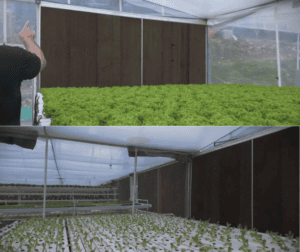
Northern Cebu is hot most of the year, yet inside this greenhouse the air is cool enough that a visitor wished for a jacket near the cooling pads. Water runs down the pads on one end, and large fans at the far end pull outside air through them. The result is a steady current that moves across every row of lettuce.
Look at the walls and you will see plastic where most greenhouses use net. Emman, the farm’s Director of Operations, explains that net lets the cool air escape through the sides before it reaches the end. Plastic keeps the air moving one way, from the pads to the fans, so none of it is wasted.
The fans are rated at 1.5 horsepower each, with smaller half-horsepower units elsewhere. The pads were imported in bulk from a supplier in China, and the farm’s own team installed them, since local suppliers cost far more. Chris, NutriHydro’s operations officer, who visited with his wife Charlie, the company’s CEO, said he could feel the air moving through the canopy. He also pointed out that the lettuce showed no tip burn.
Reading the Plants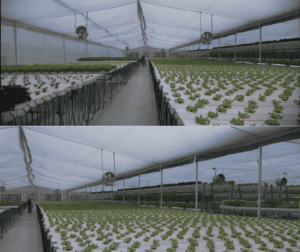
Emman does not run the fans on a fixed schedule. During the day, they work hard. At night, he usually keeps just one fan on each side, and turns on both only when humidity climbs too high. He watches the plants more than any gauge, because a spike in leaf spot tells him the humidity is getting out of hand and the fans need to stay on.
Spacing follows the same attention. Young plants stay close together for the first two weeks, then are separated gradually at weeks three to four, until they sit about six inches apart. After each harvest, the empty gutters are moved so no space goes unused. Cleaning is easier too, because an empty gutter just needs its valve shut off and a good wash.
The water carries its own information. Emman noted that when the environment is cool, the water in the system stays cool as well, and when it is hot, the water heats up with it. That is one more reason the cooling system matters so much. It protects the plants above and the roots below.
A Nursery That Rarely Fails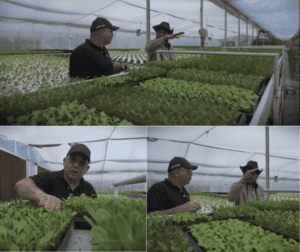
Ask Emman what drives the whole greenhouse and he points to the nursery. Seedlings sit in trays watered from the bottom in an ebb and flow system. During irrigation the water rises like a high tide, then drains away without ever going completely dry.
He has tried other methods, including overhead irrigation, and he remembers what those months felt like. At his previous companies, nursery recovery could fall to around 70 percent after a bad stretch of weather or a watering mistake. Seedlings wilted, rotted, or came up uneven. Here, recovery stays above 95 percent, and he says he no longer has to hover over the nursery. The only trouble he sees is a little algae, which does not stop anything from growing.
Each unit has its own reservoir, so if he suspects the water, he can treat it separately. Seedlings and microgreens sit in stacked layers under LED lights, which saves space. Chris was so taken with the setup that he said NutriHydro should try ebb and flow for its own seedlings, even on a small scale.
Floors, Feeds and Small Habits
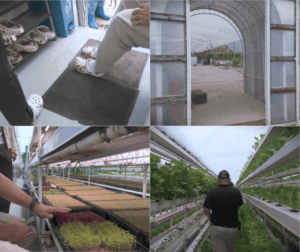 Some of the farm’s best practices are quiet ones. Visitors take off their shoes or put on foot socks and caps before going in. Another greenhouse is about to become the first on the farm with mat tiles, because epoxy floors keep needing expensive repairs. Tiles are easier to clean and hold fewer spores. Most greenhouses in the country settle for gravel or weed mat, so this is a step beyond.
The feeding of the plants is kept simple on purpose. In earlier jobs, Emman mixed nine or ten raw materials by hand, and whenever a worker took a shortcut, a crop could suffer without him knowing why. Now the farm uses NutriHydro’s ready formula, and he adds only a single element, such as boron or iron, when the plants call for it. He tried other brands, including ones from the US, and said he is staying because it does not give him a headache.
The farm also lets nature do part of the job. Dragonflies drift in from a nearby stream and hunt aphids and thrips, so Emman leaves them alone and sprays nothing that would harm them. For rows that sit under shelves, where daylight does not reach well, grow lights are switched on during bad days to make up the difference. On cloudy stretches the LED lights in the flat greenhouses serve the same purpose.
 Growing What the Market Asks For
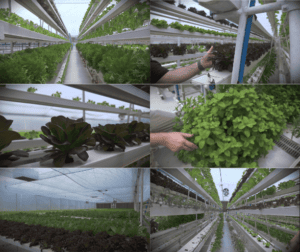
The farm plants only what someone has asked for. That is why the rows hold butterhead in red and green, romaine, frisee, baby kale, mint, tarragon and basil, along with arugula and trays of microgreens. When a customer does not like a variety, Emman offers another, and keeps adjusting until the plate looks right.
Some crops take more patience than others. Arugula is one of the hardest, since it yellows quickly in heat, and Emman says he has a few secrets that keep it healthy. Shiso is the opposite. Once it reaches six to seven weeks, he can keep cutting leaves from the same plants for as long as six months. Hotels in Makati once imported it from Japan, so he started growing it locally, and now he supplies Cebu.
The demand has been steady. A major restaurant group now buys for all of its Cebu stores and has asked about Manila. A resort that first turned down the red butterhead now orders it regularly, because it looks so good on the plate. Emman said low-tech greenhouses with nets and a few fans are heavily affected by weather and cannot grow some varieties, while this setup lets him grow them.
Where the Harvest Goes
All of this began with a storm. After Typhoon Yolanda, Ray and Debbie Goodson, an American couple, came to the Philippines and stayed. Their foundation, Rise and Rebuild, grew into three sites, all focused on feeding malnourished children in Cebu. For years it relied on donations, which could not be counted on from one year to the next.
Goodson Farm was built so the work could stand on its own. The vegetables from the open fields go to the feeding program, and the earnings from the greenhouses help keep it running. Every careful choice inside those cool rooms, from the plastic walls to the nursery trays, comes back to that purpose.
The program now feeds about 800 children, and the goal is 1,800 within six months. Plans are underway to bring the same approach to Tarlac and other places. On a quiet afternoon in Sogod, standing among rows of green with cool air on your face, you can see how all that attention to detail turns into meals for children who are waiting for them.