Next Generation Grower

The Engineer Who Measures Everything Twice and Grows Perfect Lettuce

“When I like doing something, I see to it that I study it well. Not just do it. It can’t be just like this. The product I produce needs to be good.” — Jason Sarmiento

In the shadow of Mount Banahaw, where corn fields stretch across the landscape of Candelaria, Quezon, Jason Sarmiento is rewriting the rules of hydroponic farming.

The former telecommunications engineer turned hydroponic grower has become something of a local legend—not just for his daily vlogs that inspire thousands, but for his almost obsessive commitment to excellence.

“It can’t be just like this,” Sarmiento explains, standing amid rows of pristine Maritima lettuce. “The product I produce needs to be good. It needs to be presentable, something that can be sold properly.”

The Unlikely Journey

Sarmiento’s path to farming was neither planned nor conventional. A computer engineering graduate, he spent six years with Huawei Philippines as a data communications engineer before heading to Bahrain as an OFW. The corporate grind eventually wore him down.

“I got tired of corporate life,” he admits. When his mother fell ill in 2022, he returned home with plans to trade cryptocurrency. But staring at screens all day left him feeling hollow. “There’s no physical activity. It’s like I’ll die soon because I have no exercise.”

So he tried planting. What began as a hobby quickly evolved into something more serious—much more serious.

The Perfectionist’s Approach

What sets Sarmiento apart isn’t just his engineering background—it’s his refusal to accept mediocrity. When he started in December 2022, he didn’t sell a single head of lettuce for three to four months.

This philosophy extends to every aspect of his operation. When his first bamboo greenhouse—standing only eight feet tall—proved too hot for optimal growth, he didn’t make excuses. He rebuilt it at sixteen feet. When the standard greenhouse setup didn’t maximize his space, he designed a moving NFT channel system that produces 960 heads in just 48 square meters—yielding 20 heads per square meter.

“When they grow, I adjust them to the right space,” Sarmiento explains. “Because what lettuce really needs is space. They won’t grow if they’re really stuck together.” It’s labor-intensive work, moving channels one by one as plants mature. But for Sarmiento, the results justify the effort.

When Variety Selection Changes Everything

Jason’s most significant cultivation decision involved switching from Olmetie to Maritima lettuce variety in October of the previous year. This change resulted from careful observation of performance differences and customer feedback analysis.

Since implementing Maritima, pest pressure has virtually disappeared from his operation. Previous summers with Olmetie brought significant white fly infestations and subsequent plant stunting. The same conditions with Maritima produced no comparable pest issues.

Performance metrics demonstrate Maritima’s advantages: consistent harvests at 36-37 days from seed, with individual heads weighing 120-150 grams. The variety shows resilience across varying weather conditions, maintaining quality during both sunny and rainy periods.

The Science of Success

Ask Sarmiento about his secret, and his answer is refreshingly straightforward: “Regularly check your EC and pH.”

It’s the engineer in him speaking—measure, measure, measure. While some growers rely on intuition or luck, Sarmiento treats farming as the science it is.

“Hydroponics is science-based, so in science, there are meters, so let’s use them if you want your plant growth to become competitive,” he insists. “If it’s not in the right range, no matter what you do, it won’t grow like this.”

The proof is in his greenhouse. His Maritima lettuce—uniform, vibrant, and no yellow patches. No stunted growth. Just row after row of picture-perfect lettuce.

The Daily Discipline of Observation

Sarmiento’s greenhouse management operates on a different frequency—one tuned not to rigid schedules but to the subtle language of temperature, humidity, and plant behavior. Where conventional wisdom dictates deploying shade nets at 10 AM sharp, Jason steps into his greenhouse and feels. Some mornings, the heat builds with unusual aggression, and shade goes up at 8 AM. Other days, the standard timing holds. His misting system embodies the same intuitive precision: a mere 10 to 15 seconds of activation, triggered not by timer but by the first whisper of plant stress.

But don’t mistake intuition for guesswork. Jason’s irrigation timing dances with the seasons—thirty minutes on, fifteen off during daylight in cooler weather, then inverted at night to forty-five minutes off, fifteen on. It’s a rhythm that defies the common practice of shutting down pumps after dark. “I want to prevent the roots from drying out at night,” he explains, understanding what many miss: that respiration doesn’t sleep, that growth happens in darkness, that roots need oxygen even when photosynthesis pauses. The engineer in him measures everything twice. The farmer in him knows when to trust what can’t be measured at all.

Space as Strategy

“The inside of a greenhouse is for planting, not for touring,” Jason declares, unapologetic. Every centimeter surrendered to comfort is a centimeter stolen from production. This ruthless space allocation delivers 20 heads per square meter—nearly double what conventional layouts achieve. The real genius reveals itself in motion: as lettuce matures, Jason physically shifts entire NFT channels, choreographing a slow dance of spacing adjustments. It’s backbreaking work, moving 960 plants incrementally through their life cycle. But this mobile system achieves the impossible—maximum density without sacrificing individual plant development.

Even waste becomes a strategy. Those three-ounce plastic cups holding his seedlings? They cost 20 centavos and never come back. The expensive net pots he tried first? “They’d say they’ll bring them back, but only return a few,” he recalls with a rueful smile. The disposable cups win on three fronts: cheaper upfront, use less coco peat, and let roots emerge faster into the nutrient solution. The channels themselves slope precisely—one inch drop per forty inches—engineered for perfect nutrient film flow. It’s the engineer’s mind finding elegance in disposability, turning every constraint into calculated advantage.

The Customer-First Philosophy

When clients call, any hour, any circumstance, Jason moves. Not because he’s desperate for sales, but because he’s built something rarer than perfect lettuce: perfect reliability. “When I earn, and the person I sold to uses it in their business and earns too,” he says, articulating an economics of mutual prosperity that sounds almost naive until you see it working. Jason doesn’t just deliver lettuce—he learns businesses. He asks about menu changes, foot traffic, weekend rushes. Some might call it being tsismoso, a gossip. Jason calls it relationship-building. His customers become advocates not because his lettuce is cheaper, but because he’s become invested in their success.

The quality obsession feeds everything else. From his first harvest, Jason refused to sell anything less than pristine—no yellow patches, no stunting, just relentless consistency. “First impressions last with clients,” he notes. Two hundred heads every other day, without fail. Standards that never slip. Flexibility when timing matters but never at quality’s expense. It’s a business model built on the radical idea that excellence plus reliability creates its own demand. In Jason’s world, the product opens doors. The service keeps them open.

Building A Community

Despite running what he modestly calls a “backyard farm,” Sarmiento has become a hub in the hydroponic community. His daily vlogs draw devoted followers who wait for his updates. He’s created a group where growers help each other, share knowledge, and troubleshoot problems together.

His greenhouse installations, done in collaboration with Silver Greenhouse and Virgilio Montes, have become models of practical design. And his willingness to share both successes and failures has made him a trusted voice in the industry.
Apart from that, his relationship-building approach extends beyond simple delivery transactions. Jason invests time understanding each customer’s business requirements, operational challenges, and quality expectations. This deeper engagement creates trust-based partnerships that generate referrals and expand his customer network.

Customer loyalty manifests in their preference for his Maritima variety over the previously supplied Almette. The clients appreciate both the improved flavor profile and the complete leaf utilization possible with Maritima’s structure.

The View from Mount Banahaw

Standing in his greenhouse with Mount Banahaw visible in the distance, Sarmiento embodies a particular kind of Filipino excellence—one built not on shortcuts or hype, but on discipline, curiosity, and an uncompromising commitment to quality.
“What I learned in business is you’ll earn, and the person you sold to, if they use it in their business, they’ll earn too,” he reflects. It’s a philosophy of abundance rather than scarcity, of building rather than extracting.

From sixty heads to hundreds, from a bamboo structure to multiple greenhouses, from corporate engineer to master grower—Jason Sarmiento’s journey is still unfolding. But one thing is certain: wherever he goes, he’ll measure twice and cut once, ensuring that every plant, every system, every decision meets his exacting standards.

Because for Jason Sarmiento, it can’t be just like this. It has to be perfect.

The Engineer Who Measures Everything Twice and Grows Perfect Lettuce Read More »
A Young CEO From Thailand Making Food Safety His Mission

The path from farm to fork should never compromise health—that’s the heart of food safety.

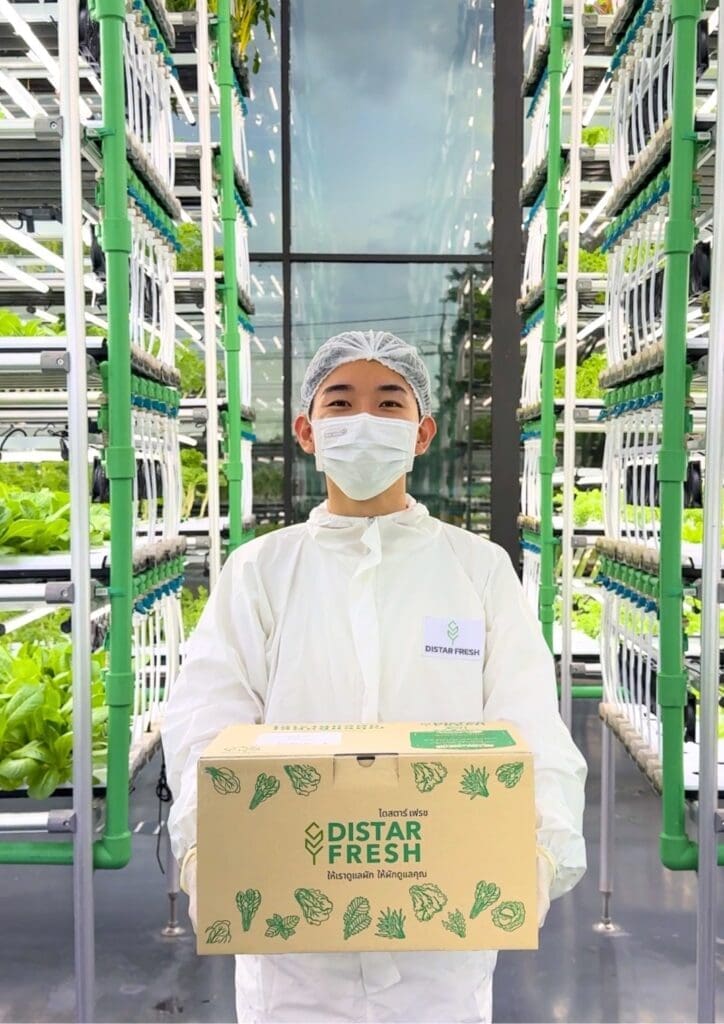
In a nondescript industrial area outside Bangkok, something extraordinary is growing—literally reaching toward the ceiling. DiStar Fresh, Thailand’s largest vertical farm, stretches 10 stories high within a single room, producing over 10 tons of pesticide-free leafy greens each month from just 400 square meters of floor space.
The man behind this agricultural revolution is Sansin Sriphiromrak, known to friends as Chane, a 28-year-old Mahidol University graduate who has become a leading voice in Asia’s Controlled Environment Agriculture (CEA) movement. His mission extends far beyond maximizing yields—it’s about reimagining food safety in a region where, as he puts it, “nature is not safe anymore.”

A Sterile Symphony of Growth

Entering DiStar Fresh feels more like stepping into a medical facility than a farm. Visitors must don complete PPE—coveralls, sanitized footwear, and hair nets—before entering the cultivation area. The reason is simple: in a closed system, one contaminant can destroy an entire harvest within hours.

“Bio security is essential in indoor farming,” Chane explains as he guides visitors through his facility. The 7-meter-high room houses 60,000 growing slots across its vertical layers, each one part of a carefully orchestrated system that maintains temperatures around 26-27 degrees Celsius and humidity at 75%.

The farm operates on a precise three-hour water cycle followed by one-hour dry periods, allowing roots to experience both hydration and crucial aeration. Custom-designed LED lights deliver specific light spectrums—red for flowering, blue for robust growth, and even far-red at 730 nanometers for optimal photosynthesis.

The Economics of Clean Food

What sets DiStar apart isn’t just its technology, but its business model. While conventional Thai farmers receive just 5 baht per plant that eventually sells for 40 baht in retail, DiStar sells directly to consumers through subscription services at the same 40-baht price point—but keeps the entire margin to reinvest in quality and safety.

“People literally pay for the subscription for us to care for their lettuce,” Chane says. “Everyone owns—there’s an owner for all of these plants. They know where to go the moment they’re harvested.”

This direct-to-consumer approach allows DiStar to deliver vegetables within 24 hours of harvest, preserving crucial enzymes and vitamins that typically degrade during the traditional supply chain’s 4-7 day journey from farm to consumer’s refrigerator.

The subscription model creates predictable revenue streams that enable DiStar to invest in expensive equipment and maintain rigorous quality standards. Customers commit to weekly deliveries of 10 units of mixed greens, creating a loyal base that values safety over convenience. This contrasts sharply with retail agriculture, where farmers must compete primarily on price rather than quality, leading to the systemic compromises that plague conventional farming across Southeast Asia.

Fighting an Uphill Battle

The necessity for such extreme measures becomes clear when Chane discusses Thailand’s food safety landscape. While organic produce in Thailand typically tests for 48 pesticides, DiStar’s greens undergo screening for 693 different pesticide residues through European lab Eurofins—14 times more comprehensive than organic certification requires.

The numbers are sobering: 100% of conventional Thai bok choy and Chinese kale in markets contain pesticide residues, with 88% at dangerous levels. Recent scandals, including imported grapes found to contain over 50 types of banned chemicals, highlight the systemic challenges facing Southeast Asian food safety.

“In Thailand, pesticide produce can be labeled as organic,” Chane explains. “How do you compete with that? We just escape that supply chain entirely.”

The regulatory environment compounds these challenges. When Shine Muscat grapes from China were found to contain over 50 banned chemicals across 23 of 24 samples tested, Thailand’s FDA still declared 7 tons of the imported fruit “safe to consume.” Such contradictory messaging erodes consumer confidence and creates an environment where fraudulent labeling thrives. The lack of meaningful consequences for violations means that premium-priced “organic” products often carry higher pesticide loads than cheaper alternatives from local fresh markets.

Innovation Through Necessity

DiStar’s solutions emerge from practical challenges. The farm uses inorganic substrates—perlite from volcanic rock and vermiculite—instead of organic materials like coconut coir that can harbor pests in closed systems. Custom-made stainless steel tanks, PPR food-grade pipes, and specialized black growing trays (which research shows increase yields by 5% by keeping roots in darkness) all contribute to the sterile environment.

The facility is completely sealed from the outside world, with CO2 supplied from tanks and oxygen generated by plants. This isolation is crucial—DiStar sits surrounded by rice fields where drones spray pesticides daily.

“We are very afraid of insects,” Chane admits. “We are surrounded by rice fields. There are drones spraying pesticide every day.”

Every component serves multiple purposes in this closed ecosystem. The custom LED arrays combine multiple light spectrums—680nm and 730nm for photosynthesis, blue light for anthocyanin production in red oak lettuce, and white light for overall plant health. The lighting schedule includes deliberate dark periods, not just to save energy, but to prevent plant stress and allow natural rest cycles. Even the flooring uses polyurethane coating specifically chosen because pathogens cannot survive on its surface, while the aluminum support structures resist corrosion and provide precise sloping for the nutrient film technique (NFT) water system.

Scaling the Future

The farm employs 20 people across two shifts, paying “office salaries” to elevate the farming profession. Night shift workers handle transplanting and germination, while morning crews manage harvesting and processing. The operation runs with military precision—any violation of biosecurity protocols results in immediate termination.

DiStar doesn’t patent its innovations or sell technology packages. Instead, Chane offers consulting and workshops, believing that knowledge sharing will accelerate the adoption of safe growing practices across the region.

“We are farmers,” he emphasizes. “This is just a tool. If there’s anything better than this, we are ready to hop on.”

The knowledge-sharing approach reflects Chane’s broader philosophy about agricultural transformation. Rather than hoarding trade secrets, DiStar opens its doors to competitors, government officials, and aspiring farmers. The company has trained teams from other Southeast Asian countries and regularly hosts delegations studying vertical farming implementation. This openness stems from a calculated bet: that widespread adoption of clean farming practices will create a larger market for premium produce, ultimately benefiting all participants more than maintaining a technological monopoly in a small niche.

The Bigger Picture

Four vertical farms have already failed in Thailand, not due to growing challenges but marketing difficulties. DiStar’s success stems from building consumer trust through transparency and education, differentiating itself in a marketplace where, as Chane notes, “fake organics are everywhere.”

The farm’s most popular crop isn’t exotic—it’s kale, driven by superfood trends and the difficulty of finding clean versions of pest-prone vegetables. Thai staples like bok choy and Chinese kale, despite being inexpensive in markets, command premium prices when grown pesticide-free.

The failure rate among vertical farms reveals the complexity of disrupting established food systems. Technical excellence in cultivation means nothing without market acceptance, and market acceptance requires consumer education about why paying premium prices for indoor-grown produce makes sense. DiStar invests heavily in transparency—publishing test results, hosting facility tours, and maintaining detailed documentation of growing processes. This approach contrasts with competitors who focused on selling technology solutions rather than building sustainable food businesses. The lesson extends beyond farming: in industries where trust has been eroded by widespread fraud, transparency becomes a competitive advantage that can’t be easily replicated.

A Vision for Southeast Asia

Looking ahead, Chane sees controlled environment agriculture as inevitable across Southeast Asia. With rivers poisoned by arsenic and soil contaminated by decades of chemical use, the choice isn’t between natural and artificial growing methods—it’s between safe and unsafe food.

“Nature is not safe anymore,” he reflects. “That’s why we are running indoors. A farm like this is like a building—10 years, 20 years. It’s literally a factory of greens.”

As consumers across the region become more health-conscious and food safety scandals continue to emerge, DiStar Fresh represents more than just an innovative farming method. It’s a blueprint for how technology can rebuild trust between producers and consumers, one carefully controlled harvest at a time.

The regional implications extend beyond individual health concerns. Southeast Asia’s rapid economic development has created a growing middle class willing to pay premium prices for safe food, but existing agricultural systems haven’t adapted to meet this demand. Climate change compounds the challenge—extreme weather events, shifting rainfall patterns, and rising temperatures make outdoor cultivation increasingly unpredictable. Countries across the region face similar pressures: urbanization reducing arable land, aging farming populations, and the environmental costs of intensive chemical agriculture. Chane’s model offers a scalable response that could be replicated from the Philippines to Vietnam, creating a new paradigm where food security and safety aren’t competing priorities.

In a world where the question is no longer whether food looks fresh but whether it’s actually safe, DiStar’s sterile towers may well represent the future of farming—growing up, not out, in pursuit of something that should be simple but has become revolutionary: truly clean food.

A Young CEO From Thailand Making Food Safety His Mission Read More »

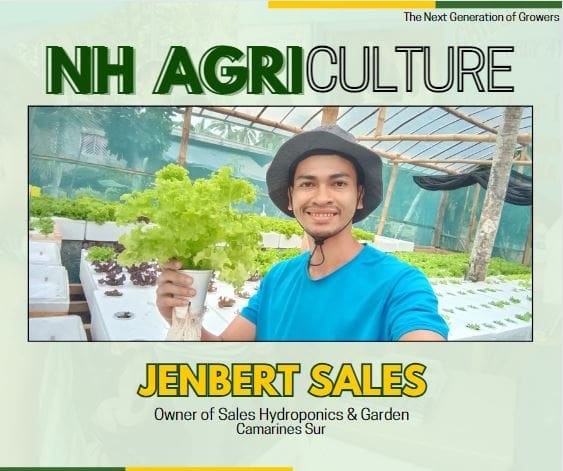
Jenbert Sales: A Growth from Research to Rooted Success

Jenbert Soto Sales, a dedicated hydroponics grower from Camarines Sur, Philippines, has seen his passion for agriculture blossom from a research role into a thriving business, “Sales Hydroponics & Garden.” This article explores his journey, highlighting the challenges and triumphs he encountered, the practices that ensure his farm’s high-quality yields, and his vision for the future, which includes inspiring others through education and knowledge sharing.

Jenbert Sales: A Growth from Research to Rooted Success Read More »

Cultivating Green Innovation: Drip Fertigation System Optimization

City of Greens Farm, established at the peak of the pandemic lockdown, exemplifies the spirit of experimentation in hydroponics. Owner Norman Ang initially faced challenges with insufficient water flow, inadequate temperature management, and limited knowledge. To address these issues, he implemented a drip fertigation system in 2023. This method offers advantages like simplified maintenance, reduced environmental impact, and precise water delivery.

Cultivating Green Innovation: Drip Fertigation System Optimization Read More »

Arcie King Macapagal: A Hydroponic Pioneer in Guiguinto, Inspiring Growth and Innovation

Embark on the hydroponic success journey of Arcie King Macapagal, a former bus conductor turned innovator in Guiguinto, Philippines. Leading the family-managed venture, Green Pasture, Arcie cultivates a diverse garden using various hydroponic systems. His story unfolds with a transformative partnership with NutriHydro, overcoming challenges, and uplifting others. Immerse yourself in the pursuit of sustainable growth and learning alongside Arcie.

Arcie King Macapagal: A Hydroponic Pioneer in Guiguinto, Inspiring Growth and Innovation Read More »

Nagcarlan Hydroponic Growers: Cultivating Unity and Success in Laguna

Embark on a hydroponic odyssey with Nagcarlan Hydroponics Growers in Laguna, Philippines. From Rodger Coronado’s Kratky beginnings to their collective resilience in the face of a typhoon, witness a community that thrives on unity and innovation. Explore their commitment to excellence, principles of shared growth, and the fruitful partnership with Nutrihydro. Join them in sowing the seeds of success and community empowerment.

Nagcarlan Hydroponic Growers: Cultivating Unity and Success in Laguna Read More »

Engr. Cristina Ramirez-Padua: Nurturing Growth and Greenery in the Heart of Caloocan

Engr. Cristina Ramirez-Padua, an urban hydroponics pioneer, showcases how hydroponics can transform not just gardening but also family bonding and community engagement. Explore her remarkable journey from a hobbyist to a seasoned expert, nurturing growth and greenery in the heart of Caloocan.

Engr. Cristina Ramirez-Padua: Nurturing Growth and Greenery in the Heart of Caloocan Read More »

Scroll to Top