
 Some farms are planted to earn a profit. Others are planted so that someone, somewhere, has something to eat. On a limestone hill in Cebu, four hectares are doing both at once, and the woman running the operation has only been in the role for a short while, yet she moves through the rows like someone who has farmed for years.
Jilesa is the officer in charge of open field farming at Rise and Build International Foundation. Chris, an operations officer at NutriHydro, paid the farm a visit to see how the vegetables grow before they eventually feed more than eight hundred malnourished children across Cebu. When Jilesa first arrived at the farm, the crops were not yet fully established. Today, she oversees the full four hectares, all of it following a system rarely seen on farms in the Philippines.
The System Behind the Rows Has a Name
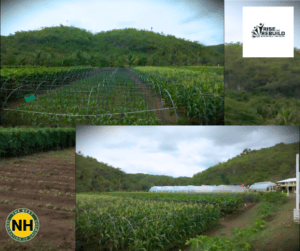
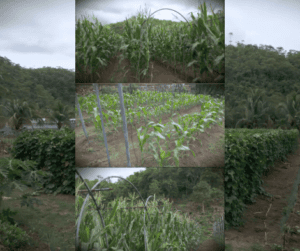 They call it the Mittleider method, and even though the name came up again and again during the walkthrough, it is far from just a buzzword. It explains why their squash looks nothing like the squash most people picture crawling along the ground. At Rise and Build, the squash is trained to climb steel arches shaped like domes, so instead of sprawling across the soil, it grows upward.
The effect goes beyond appearance. According to Jilesa, plants are easier to manage once they are lifted off the ground. Pruning becomes simpler, inspecting the fruit takes less effort, and watering is more precise because growers can see exactly where it needs to go. There is also a quieter benefit in how air moves through the plants. When vines are left to tangle and pile up, the leaves curl in on themselves and the plant struggles to breathe, almost as if it were suffocating under its own growth.
That same reasoning is why each squash bed is planted with only a single row, while corn nearby gets two rows side by side. Two rows of squash would crowd the vines too tightly, choking off the airflow the plant depends on to grow well.
Fifty Four Beds, One Month Left to Bloom
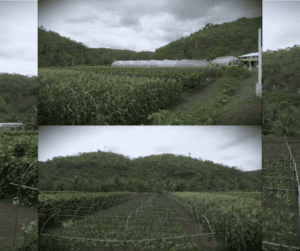 The farm currently has 54 beds of squash, with roughly 14 to 15 plants per row. Squash usually takes three to four months before it flowers, and the plants Chris and Jilesa walked through were only two months in, meaning another month of waiting before the first blooms appear.
Timing turns out to be one of the quiet secrets behind how the farm runs. Rather than harvesting everything at once, different sections follow a staggered rotation, so that one part of the farm is ready to harvest while another is still weeks away. If the entire farm produced corn or squash all at the same time, the children relying on the harvest would end up eating the same thing for weeks on end. Spacing out the harvest schedule keeps a steady variety of food moving toward the feeding program all year round.
Nothing Goes to Waste, Not Even the Space Between Rows
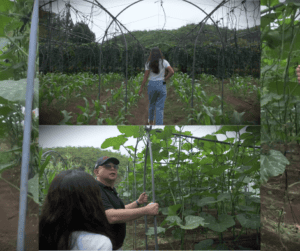 One detail easy to miss unless it is pointed out is how the space between rows gets used. In beds planted with a single row of squash, the open ground on either side is not left to weeds. Instead, it holds companion crops like kangkong and pechay, including the greener variety more commonly known as bok choy.
That is not always possible, though. Plots planted with two rows, like the corn beds, leave no room for anything else. The same limitation shows up with bushier crops like eggplant, whose broad leaves block sunlight from reaching anything planted beneath them. That is why, even though Chris hoped to intercrop basil and mint on his own farm using a similar layout, Jilesa’s warning was it might not work, given how much shade an eggplant plant can cast. The plan for now is simply to test it and see what actually happens.
Irrigation Hiding in Plain Sight
Walking through the farm reveals another detail that a casual visitor could easily overlook, the irrigation pipes running along the center of each plot. That turns out to be the reason behind the double mounded beds used throughout the farm, since the channel between the two mounds is exactly where the water flows and floods the roots. It is a small design choice, but it says a lot about how deliberately the whole system was built, where even the shape of a bed and the path of the water serve a specific purpose.
For fertilizer, the farm relies mainly on urea, potash, DAP, and ammonium. NutriHydro also offered to support them with a foliar fertilizer carrying trace micronutrients like iron, zinc, copper, boron, and molybdenum, an added boost meant to keep the plants healthier still.
 More Than Just Squash and Corn
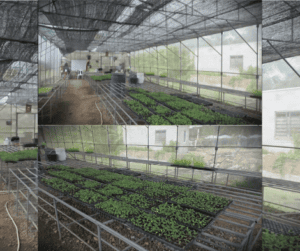
Beyond squash and corn, the four hectares hold a wide mix of vegetables. Baguio beans, okra, eggplant, and patola all have their place, along with sweet potatoes rotated across different sections of the farm. One especially interesting find is a variety of patola called mutya, distinct from the varieties typically grown in Luzon, since it does not just fruit once. It keeps producing continuously, often for two to three months straight.
Not everything on the farm is without its challenges. Some plants have developed leaf spots, a common vegetable disease, and the affected crops are being cleared out to make way for the next cycle. It is an honest reminder that even a well designed system still needs daily attention to keep plants healthy.
The Reason Behind All of It
 Behind every technical detail, from the Mittleider method to the staggered harvest schedule, sits a much bigger purpose. Rise and Build International Foundation grows food to feed malnourished children across Cebu. As of now, they are feeding more than eight hundred children, with a target of reaching 1,800.
The farm also serves as a source of livelihood for the surrounding community. Most of the farm workers come from nearby, so while the harvest goes toward feeding children, the farm itself is also helping put food on the table for the families working the land.
For growers and anyone hoping to start, this farm’s story is a reminder that the right system, no matter how small the plot, can carry someone toward something much bigger. A farm does not need to start big. What it needs is attention to every row, every planting schedule, and every decision, the same way Jilesa and her team tend to theirs, one row at a time, across four hectares in Cebu.