A Young CEO From Thailand Making Food Safety His Mission
The path from farm to fork should never compromise health—that’s the heart of food safety.
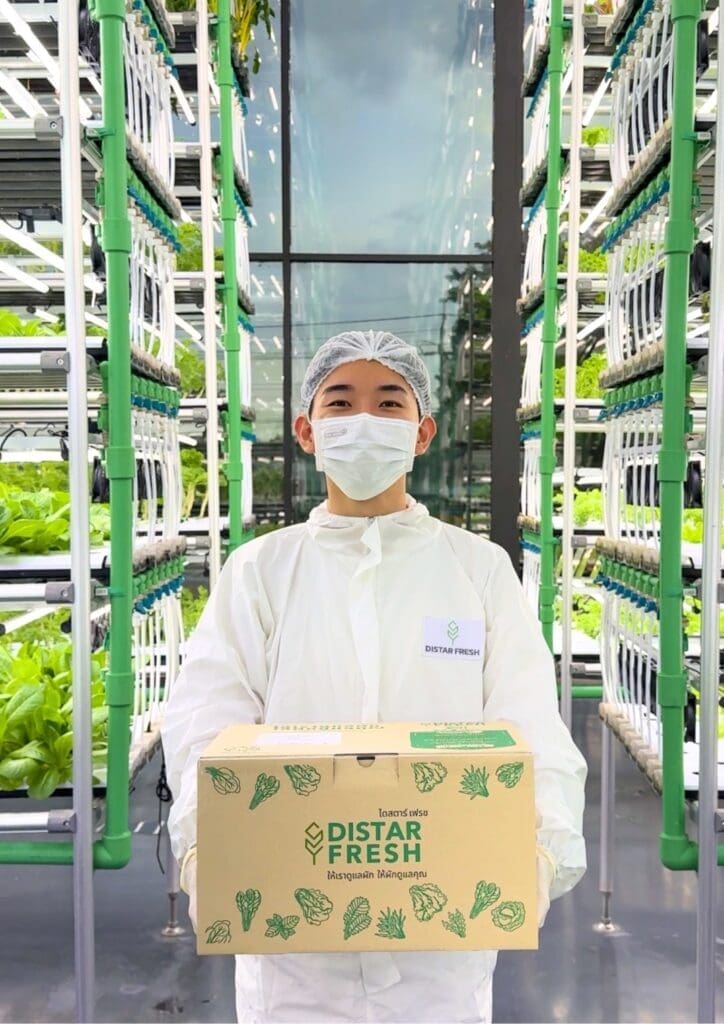
In a nondescript industrial area outside Bangkok, something extraordinary is growing—literally reaching toward the ceiling. DiStar Fresh, Thailand’s largest vertical farm, stretches 10 stories high within a single room, producing over 10 tons of pesticide-free leafy greens each month from just 400 square meters of floor space.
The man behind this agricultural revolution is Sansin Sriphiromrak, known to friends as Chane, a 28-year-old Mahidol University graduate who has become a leading voice in Asia’s Controlled Environment Agriculture (CEA) movement. His mission extends far beyond maximizing yields—it’s about reimagining food safety in a region where, as he puts it, “nature is not safe anymore.”
A Sterile Symphony of Growth
Entering DiStar Fresh feels more like stepping into a medical facility than a farm. Visitors must don complete PPE—coveralls, sanitized footwear, and hair nets—before entering the cultivation area. The reason is simple: in a closed system, one contaminant can destroy an entire harvest within hours.
“Bio security is essential in indoor farming,” Chane explains as he guides visitors through his facility. The 7-meter-high room houses 60,000 growing slots across its vertical layers, each one part of a carefully orchestrated system that maintains temperatures around 26-27 degrees Celsius and humidity at 75%.
The farm operates on a precise three-hour water cycle followed by one-hour dry periods, allowing roots to experience both hydration and crucial aeration. Custom-designed LED lights deliver specific light spectrums—red for flowering, blue for robust growth, and even far-red at 730 nanometers for optimal photosynthesis.
The Economics of Clean Food
What sets DiStar apart isn’t just its technology, but its business model. While conventional Thai farmers receive just 5 baht per plant that eventually sells for 40 baht in retail, DiStar sells directly to consumers through subscription services at the same 40-baht price point—but keeps the entire margin to reinvest in quality and safety.
“People literally pay for the subscription for us to care for their lettuce,” Chane says. “Everyone owns—there’s an owner for all of these plants. They know where to go the moment they’re harvested.”
This direct-to-consumer approach allows DiStar to deliver vegetables within 24 hours of harvest, preserving crucial enzymes and vitamins that typically degrade during the traditional supply chain’s 4-7 day journey from farm to consumer’s refrigerator.
The subscription model creates predictable revenue streams that enable DiStar to invest in expensive equipment and maintain rigorous quality standards. Customers commit to weekly deliveries of 10 units of mixed greens, creating a loyal base that values safety over convenience. This contrasts sharply with retail agriculture, where farmers must compete primarily on price rather than quality, leading to the systemic compromises that plague conventional farming across Southeast Asia.
Fighting an Uphill Battle
The necessity for such extreme measures becomes clear when Chane discusses Thailand’s food safety landscape. While organic produce in Thailand typically tests for 48 pesticides, DiStar’s greens undergo screening for 693 different pesticide residues through European lab Eurofins—14 times more comprehensive than organic certification requires.
The numbers are sobering: 100% of conventional Thai bok choy and Chinese kale in markets contain pesticide residues, with 88% at dangerous levels. Recent scandals, including imported grapes found to contain over 50 types of banned chemicals, highlight the systemic challenges facing Southeast Asian food safety.
“In Thailand, pesticide produce can be labeled as organic,” Chane explains. “How do you compete with that? We just escape that supply chain entirely.”
The regulatory environment compounds these challenges. When Shine Muscat grapes from China were found to contain over 50 banned chemicals across 23 of 24 samples tested, Thailand’s FDA still declared 7 tons of the imported fruit “safe to consume.” Such contradictory messaging erodes consumer confidence and creates an environment where fraudulent labeling thrives. The lack of meaningful consequences for violations means that premium-priced “organic” products often carry higher pesticide loads than cheaper alternatives from local fresh markets.
Innovation Through Necessity
DiStar’s solutions emerge from practical challenges. The farm uses inorganic substrates—perlite from volcanic rock and vermiculite—instead of organic materials like coconut coir that can harbor pests in closed systems. Custom-made stainless steel tanks, PPR food-grade pipes, and specialized black growing trays (which research shows increase yields by 5% by keeping roots in darkness) all contribute to the sterile environment.
The facility is completely sealed from the outside world, with CO2 supplied from tanks and oxygen generated by plants. This isolation is crucial—DiStar sits surrounded by rice fields where drones spray pesticides daily.
“We are very afraid of insects,” Chane admits. “We are surrounded by rice fields. There are drones spraying pesticide every day.”
Every component serves multiple purposes in this closed ecosystem. The custom LED arrays combine multiple light spectrums—680nm and 730nm for photosynthesis, blue light for anthocyanin production in red oak lettuce, and white light for overall plant health. The lighting schedule includes deliberate dark periods, not just to save energy, but to prevent plant stress and allow natural rest cycles. Even the flooring uses polyurethane coating specifically chosen because pathogens cannot survive on its surface, while the aluminum support structures resist corrosion and provide precise sloping for the nutrient film technique (NFT) water system.
Scaling the Future
The farm employs 20 people across two shifts, paying “office salaries” to elevate the farming profession. Night shift workers handle transplanting and germination, while morning crews manage harvesting and processing. The operation runs with military precision—any violation of biosecurity protocols results in immediate termination.
DiStar doesn’t patent its innovations or sell technology packages. Instead, Chane offers consulting and workshops, believing that knowledge sharing will accelerate the adoption of safe growing practices across the region.
“We are farmers,” he emphasizes. “This is just a tool. If there’s anything better than this, we are ready to hop on.”
The knowledge-sharing approach reflects Chane’s broader philosophy about agricultural transformation. Rather than hoarding trade secrets, DiStar opens its doors to competitors, government officials, and aspiring farmers. The company has trained teams from other Southeast Asian countries and regularly hosts delegations studying vertical farming implementation. This openness stems from a calculated bet: that widespread adoption of clean farming practices will create a larger market for premium produce, ultimately benefiting all participants more than maintaining a technological monopoly in a small niche.
The Bigger Picture
Four vertical farms have already failed in Thailand, not due to growing challenges but marketing difficulties. DiStar’s success stems from building consumer trust through transparency and education, differentiating itself in a marketplace where, as Chane notes, “fake organics are everywhere.”
The farm’s most popular crop isn’t exotic—it’s kale, driven by superfood trends and the difficulty of finding clean versions of pest-prone vegetables. Thai staples like bok choy and Chinese kale, despite being inexpensive in markets, command premium prices when grown pesticide-free.
The failure rate among vertical farms reveals the complexity of disrupting established food systems. Technical excellence in cultivation means nothing without market acceptance, and market acceptance requires consumer education about why paying premium prices for indoor-grown produce makes sense. DiStar invests heavily in transparency—publishing test results, hosting facility tours, and maintaining detailed documentation of growing processes. This approach contrasts with competitors who focused on selling technology solutions rather than building sustainable food businesses. The lesson extends beyond farming: in industries where trust has been eroded by widespread fraud, transparency becomes a competitive advantage that can’t be easily replicated.
A Vision for Southeast Asia
Looking ahead, Chane sees controlled environment agriculture as inevitable across Southeast Asia. With rivers poisoned by arsenic and soil contaminated by decades of chemical use, the choice isn’t between natural and artificial growing methods—it’s between safe and unsafe food.
“Nature is not safe anymore,” he reflects. “That’s why we are running indoors. A farm like this is like a building—10 years, 20 years. It’s literally a factory of greens.”
As consumers across the region become more health-conscious and food safety scandals continue to emerge, DiStar Fresh represents more than just an innovative farming method. It’s a blueprint for how technology can rebuild trust between producers and consumers, one carefully controlled harvest at a time.
The regional implications extend beyond individual health concerns. Southeast Asia’s rapid economic development has created a growing middle class willing to pay premium prices for safe food, but existing agricultural systems haven’t adapted to meet this demand. Climate change compounds the challenge—extreme weather events, shifting rainfall patterns, and rising temperatures make outdoor cultivation increasingly unpredictable. Countries across the region face similar pressures: urbanization reducing arable land, aging farming populations, and the environmental costs of intensive chemical agriculture. Chane’s model offers a scalable response that could be replicated from the Philippines to Vietnam, creating a new paradigm where food security and safety aren’t competing priorities.
In a world where the question is no longer whether food looks fresh but whether it’s actually safe, DiStar’s sterile towers may well represent the future of farming—growing up, not out, in pursuit of something that should be simple but has become revolutionary: truly clean food.
A Young CEO From Thailand Making Food Safety His Mission Read More »