

Most engineers solve problems with concrete and steel, but Efren Sagarino found his biggest passion growing in soil.
The morning sun filters through a 50% shade net as Efren Sagarino makes his daily rounds through MECS Hydroponics, checking each of his 1,600 lettuce plants for signs of pests or disease. At 45, with calloused hands and an engineering perspective, he embodies a new generation of Filipino farmers who are proving that innovation doesn’t always come from laboratories or universities—sometimes it emerges from necessity, persistence, and the willingness to rebuild after failure.
Five years ago, Sagarino was just another overseas Filipino worker trying to support his family after leaving civil engineering school one year before graduation. Today, his minimalist greenhouse design and DIY hydroponic innovations are being adopted by growers across the archipelago, shared freely through social media and word-of-mouth in a community that values practical solutions over patent protection. What makes Sagarino’s influence particularly powerful is his refusal to present himself as an expert—instead, he positions himself as a perpetual student of agriculture, openly sharing his failures alongside his successes in a way that makes hydroponic farming feel accessible to anyone willing to learn, adapt, and persevere.
WHEN ENGINEERING MEETS AGRICULTURE
Sagarino’s journey began with destruction. When Typhoon Odette devastated his first hydroponic setup—a simple tent-style structure—he faced a choice that would define his approach to farming: rebuild the same way, or engineer something better.
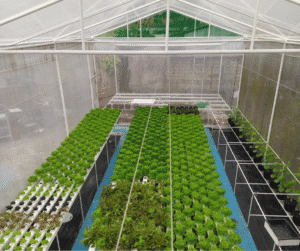 “The key insight was minimalism,” explains Sagarino, gesturing to his current greenhouse structure. “Not complicated, fast to build, clean, and functional.” His Scandinavian-inspired design uses progressively smaller pipe sizes—from 2-inch main posts down to half-inch center beams—creating a structure that has weathered three years of tropical storms while using significantly less steel than conventional designs.
But the real innovation lies in what Sagarino calls his “full NFT system” with removable covers. Traditional Nutrient Film Technique systems in the Philippines often suffer from maintenance challenges and contamination issues. Sagarino’s solution was elegantly simple: cut access panels into the growing channels, secured with detachable covers that allow complete cleaning without system shutdown.
“I was inspired by plumbing principles,” he says, demonstrating how easily the covers lift away. His engineering background helped him recognize that effective maintenance requires access to every surface where algae or pathogens might grow.
THE SCIENCE OF PRACTICAL INNOVATION
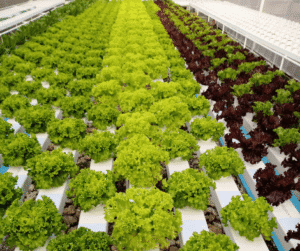 What sets Sagarino apart from many hydroponic enthusiasts is his systematic approach to problem-solving. When he noticed that his early NFT systems were experiencing root rot during hot weather, he didn’t simply accept it as an inevitable challenge. Instead, he analyzed the problem through his engineering lens.
“When water sits in the pipes, it becomes a heat absorber,” he explains, pointing to his current system where nutrient solution flows as a thin film with minimal retention. “You’re essentially cooking your plants’ roots. The solution was to ensure true film flow—manipis hanggang dulo (thin all the way to the end).”
His modifications extend beyond the growing channels. Inspired by his experience with koi pond aeration, Sagarino redesigned his reservoir oxygenation system with multiple air holes rather than the single air stone common in most setups. The result is visibly higher dissolved oxygen levels—critical for root health and nutrient uptake in tropical conditions.
These innovations didn’t emerge overnight. Sagarino describes years of experimentation, failure, and incremental improvement. His buffering process for coco peat, his double-sealing system for pipe connections, and his P-trap integration for contamination prevention all represent solutions to specific problems he encountered and solved through trial and persistence.
A PHILOSOPHY OF SHARING BEYOND THE GREENHOUSE
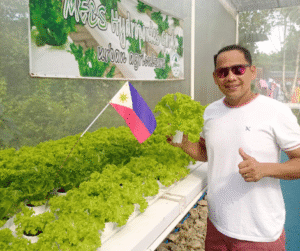 What makes Sagarino’s story particularly compelling is his approach to knowledge sharing. In an industry where proprietary techniques are often closely guarded secrets, he operates with radical transparency.
“Maraming growers pumupunta dito,” he says matter-of-factly. “We share everything. Why would you keep knowledge that can help others succeed?”
This philosophy extends to his business model. Beyond selling his produce—which achieves impressive yields of 22 heads per square meter—Sagarino offers consultation services, construction assistance, and training to anyone serious about learning. His family name itself reflects this community-oriented approach: MECS Hydroponics combines the initials of Marlene, Efren, Clint, and Sean—a business literally built on family foundation.
The impact is measurable. His removable NFT cover design has been adopted by multiple commercial operations. His minimalist greenhouse structure has been replicated across Cebu and beyond. His maintenance protocols have helped other growers avoid the disease issues that plague many tropical hydroponic operations.
 GROWING MORE THAN JUST LETTUCE
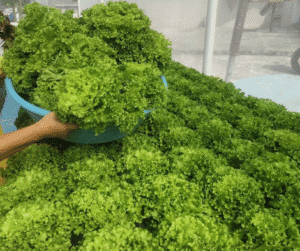
After five years of operation, Sagarino’s definition of success has evolved beyond simple production metrics. Yes, his system produces 1,600 lettuce heads every 25 days in just 72 square meters. But he measures impact differently now.
He believes true success comes when other growers don’t have to repeat the same mistakes he made, when someone builds a better system because they learned from what he shared. His daily routine reflects this philosophy. Morning inspections aren’t just about pest management—they’re about continuous observation and improvement. His weekly planting schedule isn’t just about production consistency—it’s about understanding how small changes in timing affect plant development.
Even his plant spacing strategy, learned from collaborating with other growers like Fernando Algozo, demonstrates how innovation emerges from community rather than isolation. The practice of selective harvesting and spacing adjustment didn’t originate with Sagarino, but his systematic implementation and documentation of the technique has helped other growers adopt it successfully.
 THE NEXT GENERATION CHALLENGE
Sagarino’s story raises important questions about the future of Philippine agriculture. His success demonstrates that significant innovation can emerge from small-scale operations led by practitioners rather than researchers. His systems work precisely because they’re designed by someone who must live with their daily operational reality.
Yet scaling these innovations presents challenges. While Sagarino freely shares his knowledge, the broader agricultural system lacks mechanisms to systematically capture, validate, and disseminate such grassroots innovations. His techniques remain dependent on personal networks and social media for distribution rather than formal extension services.
His family’s success story—two sons who achieved professional success through self-reliance and determination—parallels the broader challenge facing Philippine agriculture. Individual excellence and innovation are clearly possible, but systemic support structures remain limited.
 BUILDING TOMORROW’S GROWING SYSTEMS
As Sagarino plans expansion into cherry tomatoes and other crops, his focus remains on refinement rather than revolution. The principles that guide his work—minimalism, functionality, maintainability, and shareability—point toward a model of agricultural development that could be particularly relevant for the Philippines.
His success suggests that the next generation of agricultural innovation may come not from high-tech solutions requiring significant capital investment, but from systematic improvements to existing technologies made by practitioners who understand both the science and the daily operational reality of farming.
Sagarino advises aspiring hydroponic growers to remain dedicated and persistent in their efforts, emphasizing that success extends beyond individual harvests to encompass what growers help others achieve.
In an era where agricultural innovation often requires significant capital and sophisticated infrastructure, Sagarino has developed something more valuable: replicable solutions that improve with each adaptation. His techniques travel not through patents and licensing agreements, but through conversations between growers, social media posts, and hands-on demonstrations. This organic dissemination model may prove more transformative for Philippine agriculture than any venture-funded startup, precisely because it operates within the economic and social realities that most Filipino farmers actually face.