
“I chose to just stay here because I love our country. My little knowledge about farming, I always share on social media. It’s basic, at least they can learn something.” – Jezrel Palacio Carreon
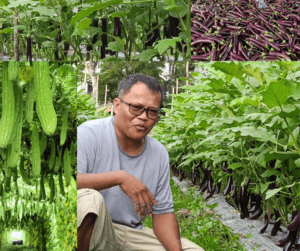
In a verdant corner of Bauan, Batangas, rows of bitter gourd vines stretch toward the sky, their fruits hanging heavy and abundant. This is not just another vegetable farm. This is Jezrel Palacio Carreon’s Talong & Ampalaya farm, the result of three decades of agricultural wisdom, commercial acumen, and an unwavering commitment to Philippine agriculture. When Jezrel chose to stay in the Philippines despite lucrative offers from San Francisco and Bahrain, he made a decision that would inspire a new generation of Filipino farmers.
A Legacy Rooted in Soil
 Jezrel’s agricultural journey began long before he became a social media presence in 2023. His family has been in the farming and vegetable trading business for 27 years, supplying produce to Cebu from their base in Zamboanga. The transition from corporate life to full-time farming was deliberate and purposeful. Before dedicating himself entirely to agriculture, Jezrel worked as a production supervisor while his wife served as a checker at a company. However, when they were blessed with children, they made a conscious choice to return to provincial life and integrated farming.
Growing up, farming was not just a livelihood but a daily discipline. Jezrel recalls having to plow fields before attending school, a routine that instilled in him both the value of hard work and deep agricultural knowledge. This foundation, built over 34 years of vegetable cultivation, would later prove invaluable when he decided to expand operations beyond Mindanao. His family’s extensive background in both production and supply chain management gave him a unique perspective that many farmers lack, the ability to think not just about growing crops but about turning agriculture into a sustainable business.
The Pandemic Pivot
 The COVID-19 pandemic brought unprecedented challenges to farmers across the Philippines, and Jezrel was no exception. With 48 staff members and 30 hectares of farmland in Mindanao, he faced a devastating reality during the lockdowns. Every day, harvest after harvest was discarded because produce could not reach markets. The waste was heartbreaking, but it sparked a strategic decision that would reshape his agricultural enterprise.
Rather than watching his land and resources go to waste, Jezrel chose to let his Mindanao property rest while exploring new opportunities in Luzon. The decision to relocate to Bauan, Batangas was calculated and strategic. Located just two hours from Manila via the Star Tollway, the area offered direct access to major vegetable drop-off points in Quezon City and Balintawak. This proximity meant his produce could reach Manila markets while still fresh, a crucial advantage in the vegetable trade. The move represented more than just geographical relocation. It was an experiment in market access, a test of whether better logistics could overcome the challenges that had plagued his operations during the pandemic.
A Partnership Built on Recreation and Production
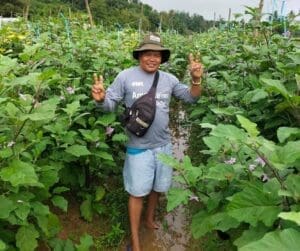 Jezrel’s current setup in Bauan demonstrates an innovative approach to land management and agricultural partnerships. The six-hectare property is not owned by him but rather operated through a collaborative arrangement with the landowners, a couple who handle San Miguel’s Coca-Cola and liquor distribution. For them, the farm serves as weekend recreation, a place to unwind and observe nature. For Jezrel, it is a proving ground for his agricultural expertise and business model.
Of the six hectares, approximately three and a half to four are dedicated to vegetables, while the rest houses calamansi, bananas, and other fruit trees. This integrated approach to farming reflects Jezrel’s philosophy that agricultural land should serve multiple purposes. The arrangement works because both parties bring something valuable to the table. The landowners provide space and resources, while Jezrel provides the knowledge, labor, and management that transforms recreational land into productive agricultural enterprise. This partnership model offers an interesting template for other landowners and farmers who might benefit from similar collaborative arrangements.
Engineering Resilience Against Nature’s Fury
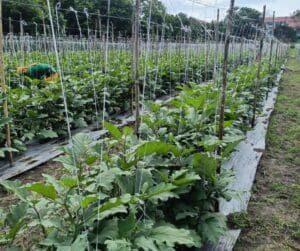
 When multiple typhoons battered Batangas, many farms in the area saw their trellising systems collapse, resulting in total crop loss. Jezrel’s farm, however, remained standing. The secret lies in his use of galvanized tie wire instead of the commonly used black twine or tri-ply rope. While conventional wisdom favors the cheaper option, Jezrel’s calculations tell a different story. Though three to four rolls of twine equal the cost of one roll of wire, the twine lasts only one season while galvanized wire can endure for decades. He still uses wire that is nearly 30 years old from his Mindanao operations.
The investment in quality materials extends beyond economics to engineering. His trellis system uses number 12 and 14 gauge galvanized wire strung between bamboo posts spaced three meters apart. At the ends of each row, posts are angled to create tension, much like a tug-of-war stance that provides stability when heavy fruits pull on the lines. According to surveys conducted by East West Seeds Company, Jezrel’s farm was the only one in the area where trellises survived the typhoons intact. While plants experienced stress and yellowing leaves, the infrastructure held firm. This resilience meant that within two weeks of the storms passing, new growth emerged and harvesting could resume, while neighboring farms were starting from scratch.
The Mathematics of Bitter Gourd
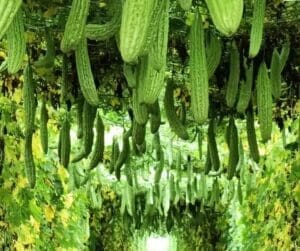 The numbers from Jezrel’s bitter gourd operation tell a compelling story about the potential of Philippine agriculture. On 1.2 hectares of land planted with Galaxy Max F1 variety from East West Seeds, a single harvest at peak production yields five to seven tons of bitter gourd. This occurs approximately 72 days after planting, and harvests continue twice weekly for up to 120 days. The variety he uses can begin producing marketable fruit in just 38 days under optimal conditions, though stress from weather can delay this to 48 days.
The progression of yields follows a predictable pattern. Initial harvests bring in modest amounts, around 200 to 500 kilograms. As plants mature and branch out, production accelerates dramatically. By the time plants reach two months of age, twice-weekly harvests of multiple tons become standard. With current farm gate prices at 180 pesos per kilogram, the revenue potential is substantial. These figures become even more impressive when considering that Jezrel manages this production without drip irrigation, relying instead on solar-powered pumps and strategic manual watering three times per week during summer months. His planting density for Galaxy Max variety follows a precise formula: two and a half meters between rows, one meter between hills, maximizing both space utilization and plant health.
Unconventional Wisdom on Pruning
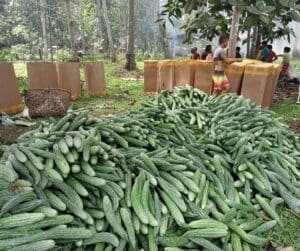 In an agricultural sector often bound by traditional practices, Jezrel has developed techniques based on careful observation and experimentation. One of his most controversial approaches involves his refusal to prune eggplant. Conventional wisdom in Philippine farming dictates regular pruning to concentrate plant energy into fruit production. Jezrel, however, conducted side-by-side comparisons and found that his unpruned plants consistently out-produced pruned ones in total yield.
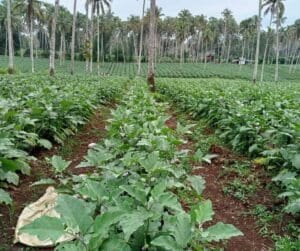
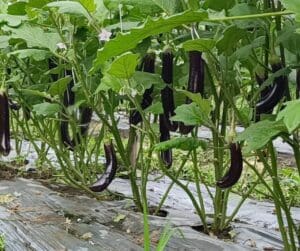
His approach is not complete abandonment of plant management but rather selective intervention. Instead of removing growing shoots and branches, he only strips away the first large leaves once plants begin fruiting. This strategy maintains maximum photosynthetic capacity while redirecting resources toward fruit development. The results speak for themselves: with 3,000 eggplant plants, his operation harvests an average of 1.5 kilograms per plant twice weekly. In one 17-month growing cycle across four hectares with 38,000 plants, his operation produced 200 tons of eggplant, demonstrating that sometimes questioning established practices can yield better results. The thick stems, abundant foliage, and prolific fruiting visible on his two-month-old Calixto variety plants provide visual confirmation of his method’s effectiveness.
Water Management in a Flood-Prone Area
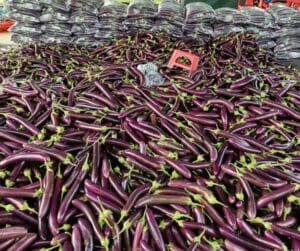 The land Jezrel farms presents unique challenges. Once part of an irrigation system for rice paddies, the property now sits at the terminus of a broken irrigation network. When heavy rains come, water from higher elevations funnels through the old irrigation channels, flooding the lower sections of the farm up to knee height. Rather than seeing this as an insurmountable obstacle, Jezrel engineered a solution through strategic bed preparation.
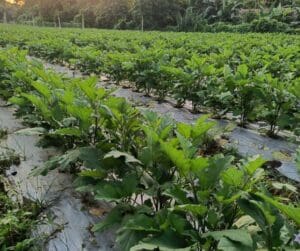
His planting beds are raised dramatically, some originally constructed eight inches deep in the center walkways, creating pronounced elevation for the growing areas. Though erosion from water flow has reduced this depth somewhat, the principle remains sound. By treating the walkways between beds as canals rather than simple paths, excess water drains away quickly, preventing the prolonged submersion that would stress or kill plants. This is particularly crucial for crops like eggplant and bitter gourd, which are sensitive to waterlogged conditions. During the recent typhoons, while the plants themselves showed stress through yellowing leaves and deformed fruits, they survived and recovered. The high beds kept root systems above standing water, and within weeks of the storms passing, new growth emerged and production resumed. This adaptation demonstrates how understanding site-specific challenges can inform infrastructure design that protects investments.
The Science of Stress and Recovery
 Walking through Jezrel’s fields reveals a living lesson in plant physiology and stress response. Among the straight, uniform bitter gourds hang curled and misshapen specimens, visual evidence of the typhoons’ impact. When plants experience severe stress, whether from wind damage, water stress, or temperature extremes, fruit development becomes irregular. These deformed fruits fetch lower prices, around 90 pesos per kilogram compared to 180 pesos for premium specimens, but they remain marketable and represent recovered value from what could have been total loss.
The resilience demonstrated by Jezrel’s crops stems partly from his post-typhoon management protocol. Immediately after storms, he applies anti-stress treatments to help plants recover more quickly. When the typhoon cut off all the growing tops of his bitter gourd plants, leaving them seemingly devastated, new shoots emerged within days. The robust root systems and healthy plant foundations he had established before the storms enabled this recovery. His eggplants, which were bearing five to ten fruits each before the typhoons hit, showed scarring on fruits that were small during the storms but continued growing afterward. New, unblemished fruits developed alongside the damaged ones, demonstrating the plants’ ability to allocate resources to new growth while maintaining existing fruit. This recovery capacity is not accidental but the result of proper nutrition, adequate spacing, good drainage, and strong trellis systems that, while not preventing stress, minimize damage and enable bounce-back.
Knowledge Sharing and National Pride
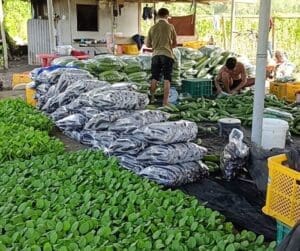 Despite receiving offers for positions in San Francisco and Bahrain that included comprehensive accommodations and expenses, Jezrel chose to remain in the Philippines. His reason is straightforward and powerful: he loves his country and wants to share his agricultural knowledge with fellow Filipinos. Through social media, he documents his farming practices, believing that even basic information can help others learn and improve their operations. His humility about calling his practices basic belies the sophistication of his approach and the decades of experience behind each decision.
This commitment to knowledge sharing recently took a formal turn. After 34 years of farming without receiving any government support, not even a single okra seed as he notes, Jezrel is now registering the San Roque Farmers Association. This registration will enable him and his workers to finally access government agricultural programs. The association represents not just his farm but a model for how small operations can organize to gain recognition and support. He remains open to consulting with aspiring farmers and is available for partner growing arrangements, extending his decades of expertise to those willing to learn. His social media presence has created a community of followers who appreciate both his technical knowledge and his willingness to share failures alongside successes, creating realistic expectations for farming ventures.
Business Acumen Meets Agricultural Heritage
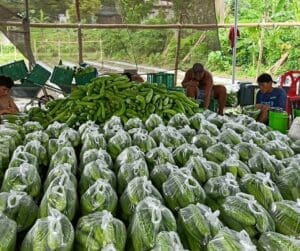 What distinguishes Jezrel from many farmers is his seamless integration of business thinking with agricultural practice. His family’s 27-year history as vegetable suppliers to Cebu provided him with crucial understanding of market dynamics, pricing, logistics, and buyer preferences. This knowledge informs decisions from variety selection to harvest timing. He understands, for instance, that malls prefer smaller bitter gourds, three to four pieces per kilogram, while institutional buyers like construction site canteens want large specimens, one per kilogram, that minimize preparation labor.
His decision to establish operations in Batangas rather than expanding in Mindanao reflects strategic thinking about risk distribution and market access. By operating in multiple locations, he spreads his exposure to localized weather events and market disruptions. The two-hour proximity to Manila’s major markets means his produce reaches consumers while still fresh, commanding better prices than produce transported from more distant regions. He sells primarily through the Tanauan market system, having stepped back from the Cebu supply chain after relocating. This business-oriented approach to agriculture, combined with his production expertise, positions him as an example of what Philippine farming could become: not subsistence agriculture dependent on government subsidies, but professional agricultural enterprise that competes on quality, efficiency, and market understanding.
A Vision for Philippine Agriculture
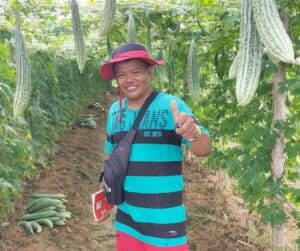 As Jezrel walks through his fields, pointing out the nuances of plant health and market preferences to visitors, he embodies a vision of what Philippine agriculture needs. Not farmers waiting for government intervention, though support is certainly welcome, but agricultural entrepreneurs who understand both cultivation and commerce. His success is built on decades of learning, willingness to invest in quality infrastructure even when it costs more initially, careful observation and experimentation, and the business acumen to connect production with markets effectively.
The six-hectare farm in Bauan is more than vegetables and trellises. It is a demonstration plot for a different approach to Philippine agriculture, one where farming is recognized as both honorable and potentially prosperous. Where a farmer’s children don’t flee to cities seeking better opportunities but see agriculture itself as the opportunity. Where the discipline of growing food becomes intertwined with the discipline of running a business. When Jezrel talks about farmers in the Netherlands driving Lamborghinis, it is not frivolous dreaming but recognition that agriculture, done well and supported properly, can generate substantial returns. His journey from Cebu to Zamboanga to Batangas, navigating pandemics and typhoons while maintaining productivity and profitability, maps a path that other Filipino farmers might follow toward similar success.