
 In a gleaming facility in the Philippines, where double-walled glass seals out the tropical heat and HEPA filters scrub the air cleaner than a hospital operating room, something remarkable is growing. Engineers who once manufactured electronics are now applying that same precision to cultivating strawberries, and the results are stunning.
Yumex Philippine Corporation, a company with roots stretching back to 1991 as an electronics manufacturer, has pivoted from assembling circuit boards and components to cultivating precision agriculture. It’s a transition that might seem improbable until you step inside their facility and witness how manufacturing discipline translates to farming excellence.
That heritage of precision manufacturing is evident everywhere. The facility operates like a cleanroom, because it essentially is one. Visitors undergo a rigorous decontamination process: changing shoes twice, donning full clean room suits, passing through two separate air showers, and using sticky rollers to remove any lint before entering the cultivation areas.
Cleanliness and Safety Protocols
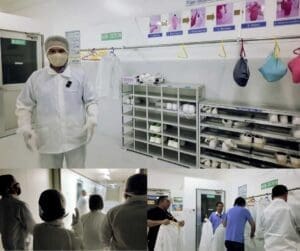 The Yumex facility maintains pharmaceutical-grade cleanliness standards that set it apart from conventional agricultural operations. As visible in the facility images, every person entering the growing areas must follow strict protocols designed to prevent contamination. The multi-stage decontamination process isn’t just theater—it’s essential to maintaining the pristine environment that allows crops to thrive without pesticides or disease.
Visitors and staff alike don complete cleanroom attire, including full-body suits, hairnets, masks, and gloves before proceeding through air shower chambers. The images show the meticulous gowning area where proper sequence instructions are displayed on the walls, and the blue air shower chambers where powerful jets of filtered air remove any remaining particles. Staff members can be seen using lint rollers as a final step before entering the cultivation zones, demonstrating the uncompromising attention to detail.
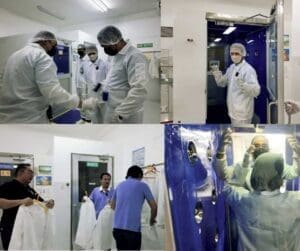 HEPA filtration systems continuously clean the air, removing particles, potential pathogens, and pests before they can enter the growing environment. This sealed, controlled approach eliminates the need for chemical pesticides entirely, resulting in produce that’s not only faster-growing but also cleaner and safer for consumption. The same discipline that once ensured zero-defect electronics manufacturing now guarantees contamination-free food production.
These rigorous safety protocols extend to every aspect of operations, from water treatment through reverse osmosis to the continuous circulation systems that prevent bacterial growth in nutrient tanks. It’s a level of care typically reserved for semiconductor fabrication or pharmaceutical production, now applied to growing strawberries and lettuce.
The Brain Behind the Operation
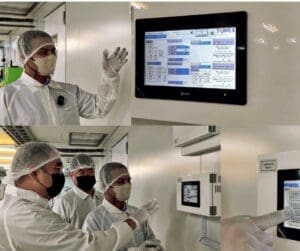 At the heart of the system is a Programmable Logic Controller (PLC) developed by Yumex, a sophisticated “brain” that manages every environmental variable with the finesse of a master conductor. Temperature, humidity, carbon dioxide levels, pH, electrical conductivity, vapor pressure deficit—all monitored and adjusted automatically in real-time.
“It’s a friendly user,” Andrew explains, demonstrating the touch-screen interface. “Just like your mobile phone can be used for this PLC type.”
But the simplicity of the interface belies the complexity of what it controls. The system manages nutrient dosing with precision down to four-second intervals, circulates water continuously through sealed tanks to prevent pathogen growth, and even controls when honeybees emerge from their hives to pollinate the strawberry flowers, all through manipulation of temperature and UV light.
The transition from manufacturing circuit boards to growing strawberries might seem radical, but the underlying principles remain remarkably similar. Both require precise environmental control, contamination prevention, systematic quality monitoring, and data-driven optimization. The company’s decades of experience in mass production and capital investment in automation created the perfect foundation for controlled environment agriculture.
Speed and Quality
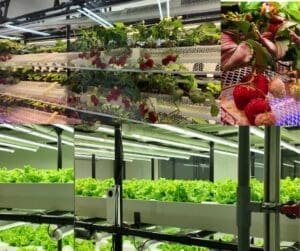 The results are striking. Lettuce that would take 80 days to mature outdoors reaches harvest size in just 30 days. Two-week-old seedlings already display vibrant, healthy leaves that would be the envy of any conventional farmer.
But it’s the strawberries that truly showcase what precision agriculture can achieve. Massive, aromatic fruits hang from plants bathed in carefully calibrated LED lighting—combinations of white and yellow bulbs (the yellow discourages insects), with some lights incorporating UV, infrared, and full-spectrum wavelengths all in one unit. These LED systems have been refined over 15 years of use in Japan.
The strawberries themselves, the Benihoppe variety, are extraordinary. The texture is described as “like butter,” with a perfect balance of sweetness and tartness that sets them apart from conventional varieties.
Controlled Everything
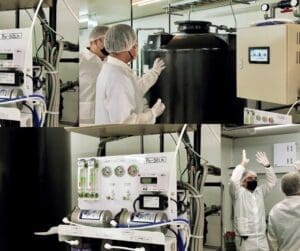 The facility’s enclosed greenhouse system maintains a completely different environment from the outside world. Double-walled glass provides insulation. Reverse osmosis filtration strips raw well water of heavy metals and minerals before nutrient solutions are precisely added back. Even the distribution pipes are mounted overhead to avoid obstructing movement.
“We try to control the environment itself,” Andrew explains. “That’s why we have to be very careful to use the whole enclosure to make it sealed.”
This control extends to managing vapor pressure deficit, a critical but often overlooked parameter that determines how efficiently plants transpire moisture from roots to leaves. Get it wrong, and nutrient deficiencies follow. Get it right, as Yumex has, and plants thrive with remarkable vigor.
Innovation in Practice
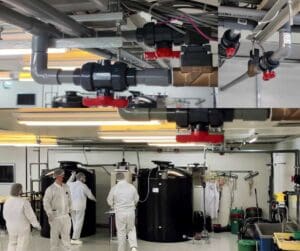 What sets Yumex apart is their engineering mindset applied to agriculture. The team is constantly testing and refining. Different LED configurations illuminate different shelf levels as they optimize light intensity and spectrum. New seedling batches are introduced alongside mature plants to demonstrate that the system can handle mixed-age cultivation—something traditional farmers typically avoid.
The approach to nutrient management reveals this engineering precision. Rather than fixating on EC or TDS numbers as absolutes, the system calculates the total quantity of nutrients delivered to plants over time. “Even if it has a small EC,” Andrew explains, “the percentage of giving the plants itself is more.”
It’s an insight that comes from thinking like a manufacturer rather than a conventional farmer—focusing on the total input over time rather than concentration at any given moment.
The Human Element
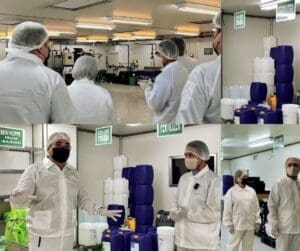 Perhaps most remarkable is the team’s humility. These manufacturing engineers readily admit they don’t know traditional farming, but that’s precisely their advantage. Unburdened by conventional agricultural assumptions, they approach cultivation as an engineering problem to be solved through measurement, control, and iteration.
Despite achieving strawberries that would be the pride of any farm, they describe themselves as still in the research and development phase, still pushing boundaries, still seeking 200% certainty before commercial deployment.
“We are on 100% stage as of the moment,” Andrew says, “but to make it sure and to give more assurance to our prospective clients, we wanted to make it 200%.”
It’s this combination—manufacturing precision, engineering innovation, and scientific rigor applied to agriculture—that may represent the future of farming. As one observer noted after touring the facility, “It’s not just the agriculturist that’s important to the cultivation industry. These three brilliant engineers, it’s gonna make a huge difference.”
The Path Ahead
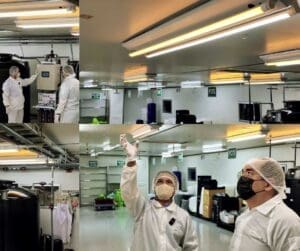 Yumex’s success raises important questions about the future of Philippine agriculture. The facility demonstrates that with proper environmental control, crops like strawberries, traditionally grown only in cooler highland regions, can be cultivated year-round in controlled environments closer to urban markets.
The technology isn’t just for strawberries. The same PLC systems have been tested on bananas, leafy greens, and other crops. The modular, customizable nature of the doser systems means farmers can precisely tailor nutrition to specific crops and growth stages.
For a country where engineers often seek opportunities abroad, Yumex represents a different possibility—one where advanced technical skills find application in revolutionizing domestic agriculture. As the team continues refining their systems, they’re not just growing strawberries. They’re cultivating a new model for how precision engineering and agriculture can merge to create something greater than either discipline alone could achieve.
The strawberries, buttery-textured and perfectly sweet-tart, are just the delicious proof of concept.