A Young Professional’s Leap into Agriculture
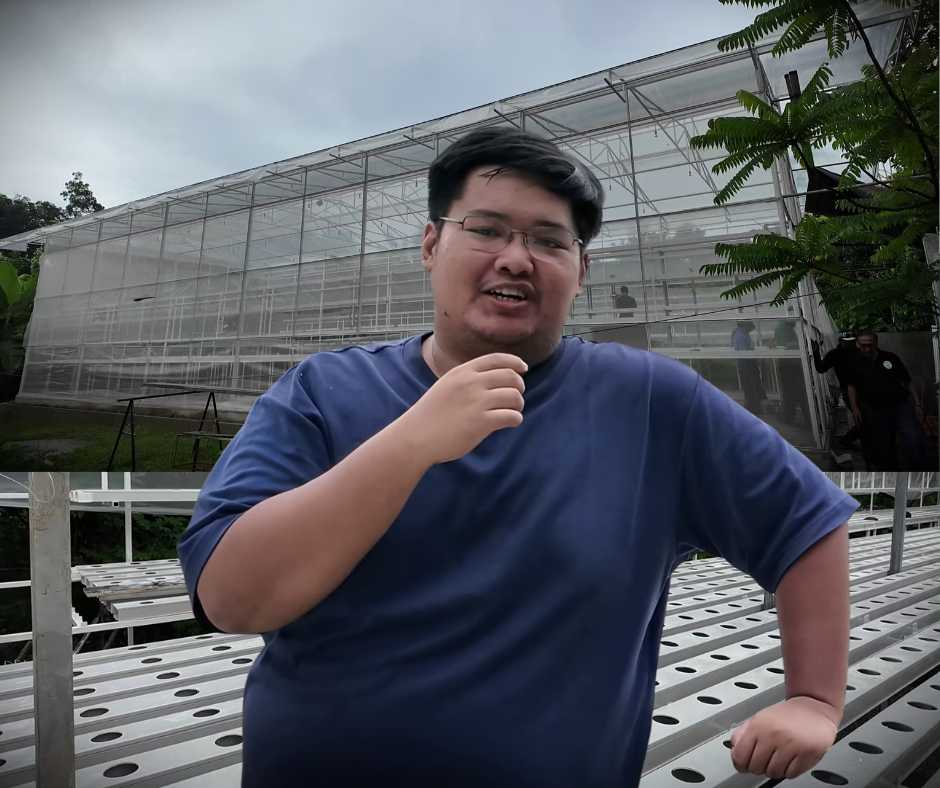
A farm visit to CLA Farm in Rizal, Laguna reveals the ambitious journey of Clarence, a young electrical engineer who traded circuit boards for cultivation beds.
“As an engineer, it’s technical, there’s data. I went to hydroponics. It’s more of a controlled environment. When you make mistakes, you’ll know why.”
— Clarence, 27, Founder of CLA Farm
The greenhouse stands tall in Rizal, Laguna—elevated, expansive, and engineered with precision. Inside, 7,000 plant sites await their first crop, organized in neat NFT channels and innovative “Christmas tree” vertical systems. This is CLA Farm, the ambitious venture of Clarence, a 27-year-old electrical engineer who’s betting big on hydroponic agriculture.
From Gaming to Growing
By day, Clarence works in game marketing for a BGC company. His favorite game? Valorant. But his real passion project unfolds in this 150-square-meter greenhouse, where his engineering mindset meets agricultural innovation. When asked what drew him to farming, Clarence reflects on his career journey from electrical engineering to business. His initial foray into traditional agriculture—growing peppers and string beans—left him frustrated with uncontrollable variables. As someone who thrived on technical data and precision, he needed something different.
That’s when he discovered hydroponics. The controlled environment appealed to his analytical nature, offering the kind of measurable outcomes he craved. When you make mistakes in hydroponics, you can trace them back to specific causes. For an engineer accustomed to troubleshooting circuits and systems, this was the perfect marriage of agriculture and technology. The curiosity that made him tinker with gadgets now found expression in pH levels, nutrient solutions, and climate control systems.
Starting Small, Thinking Big
Clarence’s hydroponic journey began modestly with a small square greenhouse featuring around 350 plant sites—a combination of NFT pipes in the center and Kratky method styrofoam boxes around the perimeter. This wasn’t a commercial operation but essentially a research laboratory where he could experiment freely. Each week brought new parameters to test, new variables to adjust, new data to analyze. The setup was decidedly DIY, complete with aquarium pumps and homemade solutions to various challenges. Heat was a constant problem. Leafminers appeared, leaving telltale lines on the leaves—Clarence simply pinched them off.
Despite the amateur setup and experimental nature of the operation, something unexpected happened: demand found him before he was ready for it. A samgyupsal restaurant approached him wanting to purchase lettuce—30 to 40 heads daily. Even in his data collection phase, the market was hungry for fresh, locally-grown hydroponic produce. But Clarence could only supply about ten percent of their requirements, maybe once a week from his small farm. The client eventually moved to a supplier who could meet their full demand.
Don Fernando Algozo, the experienced greenhouse builder who would later partner with Clarence, frames this early setback differently. In most businesses, the problem is lack of customers and declining sales. Clarence had the opposite problem—too much demand and insufficient capacity. This “good problem” planted the seed for what would eventually become CLA Farm. The market was there, waiting. He just needed to scale up to meet it.
Building the Dream
The decision to build a proper commercial greenhouse didn’t come lightly. Clarence saved up while continuing his day job in game marketing, carefully planning every aspect of the new facility. He partnered with Alfrea Greenhouse Systems, led by Don Fernando Algozo, whose three years of growing experience provided valuable insights. Together, they designed a greenhouse that incorporated lessons from multiple farms and addressed the shortcomings of Clarence’s first attempt.
The 150-square-meter structure reflects careful engineering throughout. The height is immediately noticeable—significantly taller than many commercial greenhouses. The elevation improves humidity management and airflow, critical factors in Laguna’s climate, while also allowing workers to walk underneath the elevated growing tables to access the other side. For maintenance and harvesting, this seemingly small detail saves countless hours. The site itself presented challenges, as the lot had a natural slope that required substantial backfilling to create a level growing area.
In a stroke of fortunate timing, Clarence learned that a friend’s property was being developed into an Alfamart convenience store, generating excess soil that needed removal. Instead of paying for dump trucks and purchased fill material, Clarence arranged to take the soil for free and transported it himself using a closed van from his family’s poultry operation. It was tedious, backbreaking work, but the cost savings were substantial. The backfilled foundation now elevates the greenhouse, preventing water accumulation and ensuring excellent drainage even during heavy rains.
Engineering Excellence in Every Detail
Walk through CLA Farm and the engineering touches become apparent everywhere you look. The NFT channels feature removable lids for easy cleaning, but with a critical specification that most growers might overlook. Each lid is paired to its specific channel because the manufacturing cuts in China vary slightly between pieces. Mixing them up could create gaps where the sections connect, potentially causing leaks or flow problems. The channels themselves maintain a precise one-inch elevation difference from end to end, creating a gradual slope that keeps water flowing without excessive pressure. Too steep, and the rushing water would carry plant roots along with it, destabilizing the crops. Too flat, and water wouldn’t reach all plants evenly.
Climate control relies on a sophisticated yet simple system. Six circulating fans positioned throughout the greenhouse work in zones, each controlled independently based on readings from multiple hygrometers. The fans don’t run continuously but operate in short bursts of approximately three minutes, just long enough to stabilize temperature in their designated area. The roof design incorporates wide mesh openings that allow hot air to escape rapidly while keeping insects out. Combined with intake fans at one end and exhaust fans at the other, this creates effective air circulation that prevents heat buildup—one of the biggest challenges in tropical greenhouse farming.
At the heart of the system sits a 4,500-liter reservoir that holds the nutrient solution. This substantial volume isn’t just about capacity—larger water volumes maintain more stable temperatures and dissolved oxygen levels, creating a more forgiving system that won’t crash if something goes wrong for a few hours. A Fresh and Grow unit will be installed to remove chlorine from the municipal water supply while simultaneously cooling the water and increasing dissolved oxygen levels through agitation. The Christmas tree vertical systems add another dimension, literally. These A-frame structures maximize space utilization, potentially adding 3,000 more plant sites to the 4,000 on the horizontal tables. Every element of the design serves multiple purposes—the elevation that aids drainage also improves working conditions; the height that enhances airflow also simplifies maintenance.
The Investment Reality
When asked about costs, there’s a moment of hesitation before Clarence confirms the number: over one million pesos. This figure represents materials only, with no markup for labor or profit to the builder. Don Fernando explains that Clarence provided funds progressively as construction advanced, paying only for actual materials purchased and installed. This transparency between builder and client established trust that carried through the months-long construction process.
Breaking down that investment reveals where the money goes in a serious commercial hydroponic operation. The greenhouse structure itself—frame, covering, foundation—represents a significant portion. Then come the NFT channels and all their precisely manufactured components, imported from China and designed for durability and performance. The reservoir, plumbing, pumps, filters, and water treatment systems add more. Climate control equipment including fans, hygrometers, and electrical systems contribute their share. Even small items like connectors, adhesives, and fasteners accumulate quickly when you’re building at this scale.
The backfill work, had Clarence paid market rates for soil and delivery, could have added tens of thousands more to the total. His resourcefulness in securing free material and providing his own transport labor kept this cost off the books. Similarly, by working with Don Fernando on a materials-only basis rather than a turnkey contract, he avoided markup costs that would have pushed the project well beyond the million-peso threshold. For aspiring growers, these numbers provide crucial context for business planning and capital requirements.
The Market Challenge Ahead
Production capacity means nothing without markets to absorb it. Don Fernando speaks from experience about the harsh realities of selling hydroponic produce. In his three years of growing, he’s encountered buyers who take lettuce and never pay, or who pay but only after aggressive haggling that slashes margins to unsustainable levels. Premium quality doesn’t always command premium prices when buyers can find cheaper alternatives, even if the quality doesn’t compare.
Their strategy aims for 30 pesos per cup for premium quality lettuce. This price point reflects the true costs of producing high-quality hydroponic vegetables in a state-of-the-art facility. It accounts for the capital investment that must be recovered, the ongoing operational expenses for electricity and nutrients, the labor for cultivation and harvesting, and the inevitable losses and learning curves that any agricultural operation faces. Going lower risks making the entire venture economically unviable, turning a promising business into an expensive hobby.
The challenge is finding buyers who understand and appreciate the value proposition. Hydroponic lettuce offers advantages: consistent quality, year-round availability, reduced pesticide use, and often superior taste and texture compared to field-grown alternatives. Restaurants, hotels, and upscale grocers typically recognize these benefits and accept appropriate pricing. The mass market can be tougher, more price-sensitive, and quicker to substitute cheaper options. Clarence will need to navigate these market dynamics while maintaining volume sufficient to justify his seven-thousand-plant capacity.
Wisdom Beyond Years
At 27, Clarence displays a maturity and business sense that belies his youth. When discussing his peers who spend their time partying and pursuing luxuries, there’s no judgment in his voice—just an acknowledgment that he’s chosen a different path. The greenhouse represents delayed gratification on a massive scale: money saved instead of spent, weekends working instead of relaxing, risks taken when safer options existed. Clarence continues his marketing job even as CLA Farm takes shape because he understands that businesses require ongoing investment beyond initial capital.
His advice for aspiring growers cuts to the core issue he sees in the industry: find a proper mentor who can genuinely teach you. Too many self-proclaimed experts lack either the experience or the teaching ability to truly help newcomers succeed. The agricultural education landscape is crowded with gurus who haven’t completed formal training themselves but confidently dispense advice that may or may not prove sound.
Clarence emphasizes transparency as essential to any business relationship. Don Fernando’s willingness to discuss problems openly as they arose, rather than hiding issues until they became crises, built trust throughout the construction process. When setbacks occurred, both parties could address them collaboratively rather than adversarially. Many agricultural startups fail not because the farming doesn’t work but because the farmer runs out of money before the business matures, and having the right partner who communicates honestly makes all the difference.
The Journey Continues
As our farm visit concludes, CLA Farm stands on the threshold of operation. The infrastructure is complete, engineered and built to professional standards. The next phases—installing final equipment, germinating seeds, establishing growing protocols, and connecting with markets—will determine whether this venture becomes a thriving business or an expensive lesson. But the foundation, both literal and figurative, inspires confidence.
Clarence’s journey from a small experimental greenhouse with aquarium pumps to this sophisticated seven-thousand-plant facility happened in just a few years. The evolution reflects learning from mistakes, scaling thoughtfully rather than recklessly, and applying engineering discipline to agricultural challenges. His story resonates because it’s not about inherited wealth or lucky breaks—it’s about a young professional who identified an opportunity, educated himself, saved money, found good partners, and executed a plan.
When asked what to name his farm, Clarence settles on CLA Farm—drawn from his nickname, coincidentally similar to Mercedes-Benz’s CLA series. The name choice reflects his personality: straightforward, a bit playful, and uniquely his own. The farm isn’t trying to be something it’s not; it’s simply and confidently itself, much like its young owner.
For the broader agricultural community, particularly young Filipinos considering farming as a career, Clarence’s example offers hope and a roadmap. You don’t need to come from farming families or own vast tracts of land. What you need is curiosity, discipline, willingness to learn, and the patience to build systematically toward a goal. Start small, experiment, gather data, save capital, find mentors, scale thoughtfully, and maintain perspective when inevitable challenges arise.
The next generation of Philippine agriculture might look more like Clarence than like traditional farmers—urban professionals bringing technical expertise to growing food, applying engineering and business principles to cultivation, and bridging the gap between technology and tradition. As climate change and population growth place increasing pressure on food systems, these innovative approaches to farming become not just interesting but essential.
As we say our goodbyes, Clarence returns to checking details on his greenhouse, already thinking ahead to the next steps. CLA Farm hasn’t grown its first commercial crop yet, but it’s already succeeded in one crucial way: it exists. Many dreams remain dreams; Clarence turned his into concrete, steel, and PVC channels filled with possibility. His greenhouse stands ready, his systems engineered, his resolve tested and proven. The first crop will tell us how well theory translates to practice, but the real success is already visible—he built it, and the market is waiting, hungry for what he’s preparing to grow.